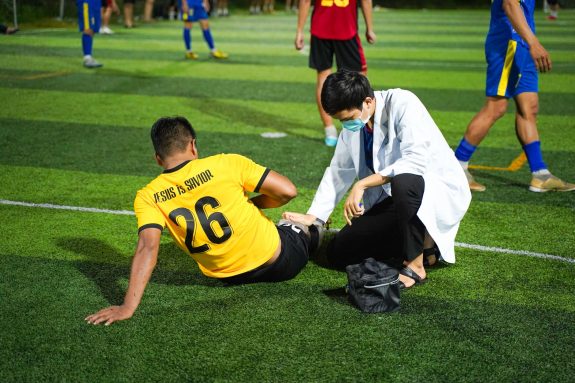
“Hamstring injury” can describe a brief interruption or a season-shaping absence.
A winger who pulls up on Saturday may be described simply as having a hamstring problem. That label reveals little: mild irritation can settle within days, while a substantial tear may require several months of rehabilitation. Even an announced injury grade is only a starting estimate, not a fixed return date.
Top Free Bets for October
BetUS
200% up to $1,000
18+. Full T&C's apply. Sports bonus: 100% match up to $500. Casino bonus: 100% match up to $500. Enter promo code NEW200 at deposit and get up to a $1000 bonus. Valid on your first three (3) deposits. Available for all deposit methods. Minimum deposit of $50.
18+. Full terms apply. The Bet Back Bonus is available for new customers on first-time deposits of $50 or more. To redeem, select the offer in the cashier while completing your first deposit. Make your pick(s) in the Sportsbook and then select ‘Opt In to Use Your Bonus’. A Bet Back Bonus pop-up will display, select ‘Claim’ and then enter the risk amount to place your bet. If it wins, you keep your profits. If it loses, get 100% of your risk refunded as Free Play with only 1-time rollover. Free Play can then be used to place bets in the Sportsbook and earn cash. Additional T&Cs apply, please visit MyBookie to access the Help Center or contact Live Chat for more details.
18+. Full T&C's apply. This promotion is available only to new accounts in North America. Freeplay amount must be wagered five times (5x rollover) before it becomes eligible for withdrawal. Only prematch (sportsbook) bets count toward the 5x rollover requirement. Each person may claim only one bonus. If a customer creates multiple accounts to exploit this promotion, bet105 will mark all related accounts as ineligible and reclaim the funds. If a client receives more than two free bets without making a deposit, any winnings from those bets will be forfeited. This promotion applies only to the initial deposit or if specifically assigned by bet105.
18+. Full terms apply. New BUSR members only. Minimum deposit of $50 required per qualifying deposits. Codes 300SB1, 300SB2, and 300SB3 must be entered at the time of each corresponding deposit.
Each code is valid one time only. Each bonus code must be claimed at least 24 hours apart. Only one promo code may be applied per deposit. A 20x rollover requirement applies to the combined total of your initial deposit and bonus before any withdrawal can be made. Redeemable in the Sportsbook only. BUSR management reserves the right to modify, suspend, or cancel this promotion at any time. Redeem each promo code in the cashier to get your bonus. Must be 18 or older. Please gamble responsibly. General House Rules Apply.
18+. Full terms apply. 100% up to $500 Bonus. Valid for non-crypto payment methods only. Minimum deposit amount $50. This offer is not available to customers from Canada or Mexico. The bonus code must be redeemed immediately after the deposit and before a wager has been placed. The sum of the deposit and the bonus are subject to rollover requirements of 12x at min. odds of -200 (1.5) before a new code can be redeemed. Max. $500 of each bet count towards the rollover requirements. Only bets placed on options that take place count towards the rollover requirements. Wagers on Horse Racing and Boosted Odds do not count towards the rollover requirements. All general Everygame Sportsbook rules apply.
21+. Full T&C's apply. Bonus: 35% of qualifying deposit, up to $105. Rollover: 8× (only sports action counts towards the rollover) deposit + bonus. Expiry: 7 days after credit. Hold period: 2 weeks. Payouts allowed only after rollover and hold period are completed. Example: Deposit $200 → Receive $50 Sports Free Play. Sports Free Play Rules: see the BetAnything General Reward Rules for eligible sports, wager types, odds, and rollover rules.
18+. Full T&C's apply. This bonus can only be redeemed on your first deposit. Rollover is 5x Sports/5x Horses/30x Casino on both the initial deposit and the bonus amount. Rollover in our Sportsbook, for winning wagers, will be determined by the lesser of your risk or win amount at the time of wager settlement; for losing wagers your risk amount will be credited to your rollover contribution. Bonus funds cannot be used for play on Live Dealer games. Live Dealer play does not count toward meeting Casino rollover requirements for withdrawal. If a withdrawal is made before the bonus terms are met, all bonus funds as well as any money earned by wagering the bonus will be forfeited.
Football’s calendar makes the numbers slippery. Three weeks out could mean missing one match during an international break, or five during a congested run of league, cup, and European fixtures. Recovery can also be extended by pain, strength deficits, or a cautious return after previous injury. Calendar time therefore matters, but likely matches missed often gives the absence its real football context.
Severity grades
What the three hamstring grades mean
Grade 1
A mild strain involving a small amount of fibre damage. Tightness or pain may be present, but strength and walking are usually only slightly affected.
Grade 2
A partial tear with clearer pain, weakness and loss of function. Running, accelerating or lengthening the stride is often difficult.
Grade 3
A complete or near-complete tear. Marked weakness, bruising and difficulty walking may occur, especially when the tendon is involved.
Interpreting the number
Grading systems differ between clinicians and imaging reports. A reported grade should therefore be read alongside the injured site and the player’s actual function.
The grade is only shorthand
Two injuries carrying the same grade can have different recovery times. Proximity to the tendon, tear length, pain, strength loss and ability to run may offer more practical guidance than the number alone. Tendon involvement commonly makes return-to-play decisions more cautious.
Recovery time by injury grade
Typical ranges vary with tear location, tendon involvement and match demands.
The grade offers a useful starting point, but it cannot set a return date on its own. These ranges assume uncomplicated rehabilitation and clearance based on strength, sprinting and football-specific movement—not simply the absence of pain.
Grade
Typical symptoms
Approximate return
Possible matches missed*
Grade 1
Tightness or mild pain, limited strength loss, walking usually comfortable
1–3 weeks
1–4
Grade 2
Sharper pain, reduced strength and range, possible bruising or altered walking
3–8 weeks
3–10
Grade 3
Severe pain and weakness, substantial bruising, sometimes a complete tear
2–4 months or longer
8–20+
*Match estimates vary widely with fixture congestion and whether reserve appearances are used during the return.
A Grade 1 strain may progress quickly from controlled running to acceleration and ball work. Grade 2 rehabilitation usually requires a longer rebuilding phase, with gradual loading at length, strength comparison between legs and repeated exposure to higher-speed running.
Grade 3 injuries often need specialist imaging and orthopaedic review. Surgery may be considered for some complete tears or tendon avulsions, making the timeline substantially longer.
A calendar date is not clearance
Returning too early can expose healing tissue to sprinting loads it is not ready to tolerate. Medical assessment is especially important when there is major bruising, marked weakness, difficulty walking or sudden pain near the tendon.
Mild strain
Grade 1: a short absence, not an instant return
Minor fibre disruption can settle quickly, but maximum-speed readiness usually lags behind comfort.
A grade 1 hamstring strain usually involves minor fibre damage, with tightness or local soreness rather than major bruising or loss of movement. Walking may be comfortable, and light jogging or modified training can sometimes restart within a few days.
Competitive football usually demands more caution. A typical return takes one to three weeks, which may mean roughly one to four missed matches depending on fixture congestion. A player injured before a quiet week could miss one game; the same recovery during a packed schedule could rule out several.
Pain settling is encouraging, but it does not prove that the hamstring can tolerate full-speed running. Sprinting, sharp acceleration, long passing and sudden deceleration load the muscle far more than jogging.
Before selection, progression commonly includes:
pain-free running at increasing speeds;
near-normal strength and range of motion;
repeated accelerations and high-speed efforts;
football drills completed without symptoms during or after the session.
Returning as soon as everyday discomfort disappears can expose an incompletely restored hamstring to reinjury.
Grade 2
Grade 2: why partial tears vary so widely
A grade 2 hamstring strain is a partial tear, and its timetable is rarely tidy. Some footballers resume match play after roughly three to four weeks; others need six to eight weeks, occasionally longer. The difference is usually clearer in function than in the grade label alone.
More extensive bruising, a noticeable loss of strength, or pain during ordinary running generally points toward the slower end. A tear high in the hamstring, especially near the sitting bone, can also be stubborn. Involvement of the intramuscular or free tendon often requires more cautious loading than damage confined mainly to muscle.
Practical estimates often look like this:
Strength returning quickly, little running pain: around 3–5 weeks
Marked weakness, bruising, or persistent pain: around 5–8 weeks
Tendon involvement or a slow-progressing high tear: 8 weeks or more
That can translate to approximately three to ten matches, but fixture density changes the competitive cost. Four recovery weeks might remove three league games in a quiet month, yet seven or eight fixtures during a congested spell. Cup ties, international breaks, and gradual substitute appearances further distort the count, so dates absent and matches missed are best considered separately.
Severe tears
Grade 3: recovery is measured in months
Complete tears and tendon injuries require a longer, less predictable return
A complete or near-complete hamstring rupture changes the expected timeline from weeks to months. A rupture contained mainly within muscle may require roughly two to four months before football, with additional time needed if strength, sprint mechanics or confidence remain below baseline. Comfortable walking is not evidence of readiness for maximal running.
When the tear extends into a tendon—or the tendon pulls away from its attachment, known as an avulsion—recovery may move toward four to six months, sometimes longer. Surgical repair usually involves an initially protected phase, followed by gradual loading and a lengthy progression through running, cutting and kicking.
The final return date should depend on function rather than the calendar. Near-normal strength, pain-free high-speed running and repeated exposure to football-specific movements are important milestones before match selection.
Surgery is not automatic
The decision depends on which tendon is injured, how far it has retracted, how many tendons are involved and the player’s competitive demands. Some tears can be managed without an operation; larger avulsions may favour repair. Imaging, examination and specialist assessment guide the choice.
Beyond severity
Why the same grade can mean a different timeline
A grade is only the starting point. Previous hamstring injury raises concern because residual weakness, scarred tissue or an earlier incomplete recovery may make sprint progression slower. Age can also lengthen the process, although training history and current physical condition often matter more than age alone.
MRI or ultrasound helps identify the tear’s length, cross-sectional size and location. A larger injury, one closer to the upper hamstring near the pelvis, or damage extending into the tendon generally carries a less predictable—and often longer—recovery than a small muscle-only strain. Scans inform the estimate; they do not prove that a player is ready to compete.
Football demands also change the practical prognosis. A winger or full-back repeatedly reaching maximal speed may need more sprint exposure than a goalkeeper or a player whose role involves fewer long runs. Persistent side-to-side strength deficits, pain during acceleration or poor tolerance of repeated high-speed efforts can delay clearance even when everyday movement feels normal.
Rehabilitation response is therefore more useful than any single calendar date. Staff watch whether running speed, strength and training volume rise without symptoms during the session or the following day. A smooth progression can bring an estimate forward; renewed tightness, pain, fatigue or a failed sprint test can push it back. This is why projected return dates change after fresh scans, field tests or a training setback.
Return pathway
From rehabilitation to 90 minutes
01
Settle symptoms and restore movement
Early work aims for comfortable walking, useful hip and knee movement, and basic muscle activation. Progress depends on the response, not simply days elapsed.
02
Rebuild strength
Loading advances from controlled contractions to heavier, longer-range hamstring work. Both legs are compared, although perfect symmetry is not always required.
03
Resume running
Easy straight-line running comes before repeated accelerations. Speed and volume increase only when the hamstring tolerates the session and the following day.
04
Add sprinting and direction changes
Near-maximal speed, braking, cutting and football-specific movements expose the muscle to demands that jogging cannot reproduce.
05
Return to team training
Modified drills may progress to full sessions and normal contact. This marks training return, but not necessarily availability for selection.
06
Build match readiness
A player may be selectable for limited substitute minutes before being ready to start or complete 90 minutes. Workload, position and recovery between fixtures shape that final step.
Weeks out do not equal games missed
A four-week recovery could cost three matches in a quiet month or seven during league, cup and European congestion. The estimate should be placed against the actual fixture calendar, including likely reserve or substitute appearances.
This staged exposure explains why recovered players are eased back in: training return, selection availability and full-match readiness are separate milestones. A medical clearance date therefore rarely predicts the exact number of missed starts.
Reading updates
How to judge signs of progress
Treat pain-free walking as an early milestone
It shows improvement in daily function, not readiness for sprinting, cutting or kicking.
Check what “gym work” includes
Cycling and controlled strength exercises place different demands on the hamstring than maximum-speed running.
Look for football-specific progression
More meaningful updates mention high-speed running, repeated sprints, changes of direction and partial team training.
Separate training return from match return
Full training may come before selection, while minutes can remain restricted after clearance.
Persistent symptoms need assessment
Severe pain, marked weakness, extensive bruising, a visible deformity or symptoms that fail to improve should be assessed by a qualified medical professional. Sudden pain near the buttock may indicate tendon involvement and deserves particular caution.
Daily comfort and controlled exercise do not prove match readiness.
High-speed, football-specific loading provides stronger evidence of progress.
Return dates should remain provisional until the player tolerates demanding running and team work without a setback. The grade offers a useful starting range, but functional progress determines when that range becomes credible.
Top Free Bets for October
BetUS
200% up to $1,000
18+. Full T&C's apply. Sports bonus: 100% match up to $500. Casino bonus: 100% match up to $500. Enter promo code NEW200 at deposit and get up to a $1000 bonus. Valid on your first three (3) deposits. Available for all deposit methods. Minimum deposit of $50.
18+. Full terms apply. The Bet Back Bonus is available for new customers on first-time deposits of $50 or more. To redeem, select the offer in the cashier while completing your first deposit. Make your pick(s) in the Sportsbook and then select ‘Opt In to Use Your Bonus’. A Bet Back Bonus pop-up will display, select ‘Claim’ and then enter the risk amount to place your bet. If it wins, you keep your profits. If it loses, get 100% of your risk refunded as Free Play with only 1-time rollover. Free Play can then be used to place bets in the Sportsbook and earn cash. Additional T&Cs apply, please visit MyBookie to access the Help Center or contact Live Chat for more details.
18+. Full T&C's apply. This promotion is available only to new accounts in North America. Freeplay amount must be wagered five times (5x rollover) before it becomes eligible for withdrawal. Only prematch (sportsbook) bets count toward the 5x rollover requirement. Each person may claim only one bonus. If a customer creates multiple accounts to exploit this promotion, bet105 will mark all related accounts as ineligible and reclaim the funds. If a client receives more than two free bets without making a deposit, any winnings from those bets will be forfeited. This promotion applies only to the initial deposit or if specifically assigned by bet105.
18+. Full terms apply. New BUSR members only. Minimum deposit of $50 required per qualifying deposits. Codes 300SB1, 300SB2, and 300SB3 must be entered at the time of each corresponding deposit.
Each code is valid one time only. Each bonus code must be claimed at least 24 hours apart. Only one promo code may be applied per deposit. A 20x rollover requirement applies to the combined total of your initial deposit and bonus before any withdrawal can be made. Redeemable in the Sportsbook only. BUSR management reserves the right to modify, suspend, or cancel this promotion at any time. Redeem each promo code in the cashier to get your bonus. Must be 18 or older. Please gamble responsibly. General House Rules Apply.
18+. Full terms apply. 100% up to $500 Bonus. Valid for non-crypto payment methods only. Minimum deposit amount $50. This offer is not available to customers from Canada or Mexico. The bonus code must be redeemed immediately after the deposit and before a wager has been placed. The sum of the deposit and the bonus are subject to rollover requirements of 12x at min. odds of -200 (1.5) before a new code can be redeemed. Max. $500 of each bet count towards the rollover requirements. Only bets placed on options that take place count towards the rollover requirements. Wagers on Horse Racing and Boosted Odds do not count towards the rollover requirements. All general Everygame Sportsbook rules apply.
21+. Full T&C's apply. Bonus: 35% of qualifying deposit, up to $105. Rollover: 8× (only sports action counts towards the rollover) deposit + bonus. Expiry: 7 days after credit. Hold period: 2 weeks. Payouts allowed only after rollover and hold period are completed. Example: Deposit $200 → Receive $50 Sports Free Play. Sports Free Play Rules: see the BetAnything General Reward Rules for eligible sports, wager types, odds, and rollover rules.
18+. Full T&C's apply. This bonus can only be redeemed on your first deposit. Rollover is 5x Sports/5x Horses/30x Casino on both the initial deposit and the bonus amount. Rollover in our Sportsbook, for winning wagers, will be determined by the lesser of your risk or win amount at the time of wager settlement; for losing wagers your risk amount will be credited to your rollover contribution. Bonus funds cannot be used for play on Live Dealer games. Live Dealer play does not count toward meeting Casino rollover requirements for withdrawal. If a withdrawal is made before the bonus terms are met, all bonus funds as well as any money earned by wagering the bonus will be forfeited.
Hi I'm Andy and I love to report on the latest football scores and Tables. I also like to have a bet on the football and occasionaly on the horses. On this website I have new bookmaker offers listed that will give you free bets and bonuses to help you beat the bookies. Enjoy your stay.