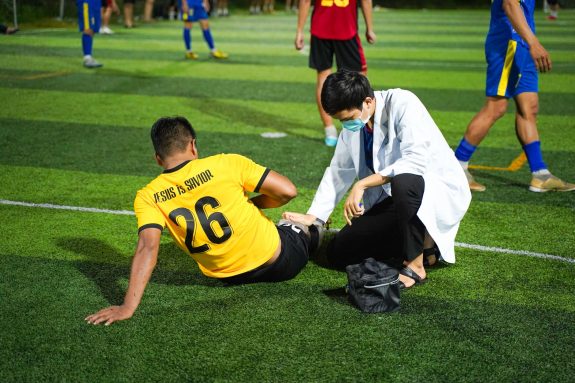
A return date can look like a promise, but it is usually a best-case estimate with conditions attached.
A player is described as “two weeks away,” two weekends pass, and his name is still missing from the squad sheet. To supporters, that can feel evasive or contradictory. Inside a recovery programme, it is often much less dramatic: the injured tissue simply has not responded as confidently as expected.
Top Free Bets for October
BetUS
200% up to $1,000
18+. Full T&C's apply. Sports bonus: 100% match up to $500. Casino bonus: 100% match up to $500. Enter promo code NEW200 at deposit and get up to a $1000 bonus. Valid on your first three (3) deposits. Available for all deposit methods. Minimum deposit of $50.
18+. Full terms apply. The Bet Back Bonus is available for new customers on first-time deposits of $50 or more. To redeem, select the offer in the cashier while completing your first deposit. Make your pick(s) in the Sportsbook and then select ‘Opt In to Use Your Bonus’. A Bet Back Bonus pop-up will display, select ‘Claim’ and then enter the risk amount to place your bet. If it wins, you keep your profits. If it loses, get 100% of your risk refunded as Free Play with only 1-time rollover. Free Play can then be used to place bets in the Sportsbook and earn cash. Additional T&Cs apply, please visit MyBookie to access the Help Center or contact Live Chat for more details.
18+. Full T&C's apply. This promotion is available only to new accounts in North America. Freeplay amount must be wagered five times (5x rollover) before it becomes eligible for withdrawal. Only prematch (sportsbook) bets count toward the 5x rollover requirement. Each person may claim only one bonus. If a customer creates multiple accounts to exploit this promotion, bet105 will mark all related accounts as ineligible and reclaim the funds. If a client receives more than two free bets without making a deposit, any winnings from those bets will be forfeited. This promotion applies only to the initial deposit or if specifically assigned by bet105.
18+. Full terms apply. New BUSR members only. Minimum deposit of $50 required per qualifying deposits. Codes 300SB1, 300SB2, and 300SB3 must be entered at the time of each corresponding deposit.
Each code is valid one time only. Each bonus code must be claimed at least 24 hours apart. Only one promo code may be applied per deposit. A 20x rollover requirement applies to the combined total of your initial deposit and bonus before any withdrawal can be made. Redeemable in the Sportsbook only. BUSR management reserves the right to modify, suspend, or cancel this promotion at any time. Redeem each promo code in the cashier to get your bonus. Must be 18 or older. Please gamble responsibly. General House Rules Apply.
18+. Full terms apply. 100% up to $500 Bonus. Valid for non-crypto payment methods only. Minimum deposit amount $50. This offer is not available to customers from Canada or Mexico. The bonus code must be redeemed immediately after the deposit and before a wager has been placed. The sum of the deposit and the bonus are subject to rollover requirements of 12x at min. odds of -200 (1.5) before a new code can be redeemed. Max. $500 of each bet count towards the rollover requirements. Only bets placed on options that take place count towards the rollover requirements. Wagers on Horse Racing and Boosted Odds do not count towards the rollover requirements. All general Everygame Sportsbook rules apply.
21+. Full T&C's apply. Bonus: 35% of qualifying deposit, up to $105. Rollover: 8× (only sports action counts towards the rollover) deposit + bonus. Expiry: 7 days after credit. Hold period: 2 weeks. Payouts allowed only after rollover and hold period are completed. Example: Deposit $200 → Receive $50 Sports Free Play. Sports Free Play Rules: see the BetAnything General Reward Rules for eligible sports, wager types, odds, and rollover rules.
18+. Full T&C's apply. This bonus can only be redeemed on your first deposit. Rollover is 5x Sports/5x Horses/30x Casino on both the initial deposit and the bonus amount. Rollover in our Sportsbook, for winning wagers, will be determined by the lesser of your risk or win amount at the time of wager settlement; for losing wagers your risk amount will be credited to your rollover contribution. Bonus funds cannot be used for play on Live Dealer games. Live Dealer play does not count toward meeting Casino rollover requirements for withdrawal. If a withdrawal is made before the bonus terms are met, all bonus funds as well as any money earned by wagering the bonus will be forfeited.
Healing does not follow a fixed timetable. Pain may settle before strength returns; straight-line running may feel comfortable while sharp turns expose a problem. Training also raises the bar far beyond being able to jog without discomfort. A player must tolerate repeated sprints, contact, fatigue and full-intensity sessions without symptoms returning. Each increase in load is both rehabilitation and a test. If swelling, soreness or weakness appears the next morning, the plan may pause or step back. “Two weeks” therefore often means two weeks if the next milestones are passed—not a guaranteed appearance date.
Reading timelines
A return date is a working estimate
The meaning of “back” matters as much as the date itself.
An estimated return date is usually a forecast based on incomplete early evidence. Scans, symptoms, previous recovery patterns, and the typical course of a similar injury may suggest a window, but they cannot show exactly how the player will respond to later training loads.
Calendar dates versus recovery milestones
A calendar prediction translates that early evidence into a convenient phrase such as “three weeks” or “after the international break.” It helps with planning and headlines, but often implies more certainty than the medical process allows. Even a date reported confidently in football injury and suspension updates may still be a target rather than a confirmed return.
A milestone-based progression asks different questions: Can the player run without symptoms? Can they accelerate, change direction, strike the ball, and complete team drills? Each successful stage supports the next one; soreness, swelling, fatigue, or reduced movement quality may lead to repetition or a temporary step back.
This explains why a date can move without the original assessment being obviously wrong. The calendar advances steadily, while recovery does not.
Reading reports
What “back” may actually mean
01
Back on the grass
The player has started outdoor work, often individually and at controlled intensity.
02
Back in team training
Some drills may be allowed, while contact, sprinting, or the full session remains restricted.
03
Back in full training
Normal sessions have resumed, but fitness and the response on the following day still matter.
04
Back in the squad
The player is available for selection, although a substitute role or limited minutes may be planned.
05
Back to match rhythm
Several appearances may be needed before workload, sharpness, and confidence resemble pre-injury levels.
When reports conflict, checking which stage each source means often resolves the apparent contradiction.
Starting range
How the first estimate is built
The opening window combines medical evidence with the realities of the player’s role and season.
An initial return range begins with the diagnosis: which tissue is injured, where the damage sits, and how severe it appears. Clinical examination and scans help establish that picture, but imaging is not a countdown clock. Similar-looking injuries can settle at different speeds.
For muscle problems, the grade provides a useful starting point, while factors such as tear length, tendon involvement, strength loss, and pain also matter. That is why published guidance on hamstring recovery times across injury grades is better treated as a range than a promise.
Player history can widen or narrow that range. A first minor strain may carry fewer concerns than another injury in the same area after repeated setbacks. Age, recent workload, previous surgery, and how the player responded to earlier rehabilitation may all influence the plan.
Football demands then modify the medical estimate. A winger expected to sprint repeatedly, a midfielder covering large distances, and a goalkeeper diving explosively do not face identical return tests. Fixture congestion, competition importance, squad depth, and the club’s tolerance for reinjury risk can affect whether the cautious or aggressive end of the range is chosen.
Beyond the calendar
Progress is earned through load
Recovery moves forward when harder football actions are tolerated without a meaningful setback.
Time allows tissue healing, but the calendar alone does not prove readiness. Rehabilitation usually advances by adding demands in stages, with medical and performance staff checking how the body responds during the session and afterward.
A typical progression might include:
pain-controlled movement and basic strength work;
straight-line running at increasing speed;
acceleration, braking, turning, and jumping;
ball work and position-specific drills;
partial, then full, team training;
controlled minutes before a full match load.
Each step asks a more football-relevant question. Can the player produce force, repeat high-speed efforts, change direction under fatigue, and recover by the following day? Pain, swelling, stiffness, reduced strength, altered movement, or an unusual drop in output may lead staff to hold the current level or reduce it.
The later stages often create the most uncertainty because training must begin to resemble competition. One successful sprint or team session is limited evidence; matches involve repeated explosive actions, contact, fatigue, and decisions made at speed. A return window therefore moves when the player progresses faster than expected, reacts poorly to a new load, or needs more exposure before the risk is considered acceptable.
Reading delays
What a changed date does—and does not—mean
Myth
A postponed return automatically means the player has suffered the injury again.
Fact
Many delays are routine recalibrations rather than confirmed re-injuries.
Why
Pain, swelling, stiffness, or fatigue after a higher-load session may require several quieter days without indicating new structural damage.
Myth
A healed scan means the player is ready for selection.
Fact
Tissue healing and football readiness are separate milestones.
Why
Strength, sprint exposure, change-of-direction control, confidence, and recovery between sessions may still fall below the required level.
Myth
A major fixture can bring the return date forward.
Fact
The schedule may influence risk tolerance, but it cannot create missing preparation.
Why
A player might be considered sooner for a final or relegation match, although restricted training often limits minutes and increases uncertainty.
Changing forecasts
A delay is not always a new injury
Different tissues—and different players—produce different levels of uncertainty.
Recalibration versus re-injury
A routine recalibration usually follows a response that the original plan did not fully anticipate. The player may develop soreness after sprinting, fail to recover before the next session, or remain short of a strength or movement target. Preparation can also be interrupted by illness, unrelated pain, poor weather, or too few suitable training days.
A confirmed re-injury is a different event. It normally involves a new incident or a clear deterioration, followed by examination and sometimes fresh imaging. Club updates may initially use cautious language because symptoms need time to settle before the difference becomes clear.
Why the tissue matters
Return dates do not carry equal uncertainty across injury types:
Bone injuries often have a reasonably trackable healing process, but location, displacement, surgery, and tolerance of impact can alter the final phase.
Muscle injuries vary by depth, length, exact site, and previous scarring. Two injuries both called a “hamstring strain” may behave very differently once high-speed running begins.
Tendon problems can fluctuate with load. Symptoms may improve slowly, then react when jumping, acceleration, or repeated training is added.
ACL recovery is lengthy and benchmark-led, with uncertainty around strength symmetry, movement quality, confidence, and match conditioning. Broader ACL recovery expectations therefore work better as ranges than deadlines.
Even apparently precise labels can hide important distinctions. A calf problem near the tendon is not equivalent to one in the muscle belly; a simple fracture is not the same as a surgically fixed one. Previous injuries, position, age, and the demands of the intended role widen those differences.
Fixture pressure complicates the final decision rather than the underlying healing. A key match may encourage an earlier squad return or a short appearance, while a quiet schedule allows more preparation. When the date moves, the useful question is not merely “Has something gone wrong?” but “Which benchmark, symptom, or training step changed the forecast?”
Reading reports
How injury updates lose detail
The source and wording matter as much as the date.
A medical assessment rarely reaches supporters unchanged. Clinicians may describe symptoms, test results and loading targets to coaching staff; a coach compresses that into “not ready” or “close”; club media removes confidential detail; journalists add context; aggregators then reduce the report to a date.
Each step can strip away conditions. “Could train next week if there is no reaction” may eventually become “returns next week,” even though the original statement was conditional. Aggregated injury tables are useful for orientation, but their neat dates can imply certainty that the underlying report never offered.
Privacy rules limit what clubs can disclose, while competitive concerns discourage revealing whether a player can sprint, tackle or strike the ball normally. Coaches may also use broad language to avoid giving an opponent selection clues. This does not automatically make an update misleading; it makes precision difficult to infer from a short quote.
Most importantly, being medically available only means selection is possible. It does not establish why a returning player may not start, how many minutes can be tolerated, or whether normal performance has returned. Availability, starting readiness and full-match readiness are separate thresholds.
Source check
How to rank the evidence
Direct club or competition confirmation
Official squad lists, matchday selection and clearly attributed medical statements provide the firmest evidence of current status.
Named coach or player comments
Read the exact wording. “Training,” “available” and “ready to start” make different claims.
Reliable reporting with specific observations
Reports of full team training or completed sessions carry more weight when the journalist identifies what was observed.
Secondary summaries and return-date tables
These are convenient but may omit caveats, recycle old estimates or treat speculation as a deadline.
Anonymous posts and unsourced claims
Treat precise dates cautiously when no original quotation, report or observable event can be traced.
Newer information is not necessarily stronger information; source quality and specificity still matter.
Conclusion
A reported date should be traced back to its earliest identifiable source and read in its original wording. Selection is the clearest proof of availability, but even an appearance may represent only a managed stage of recovery—not readiness for 90 minutes.
Top Free Bets for October
BetUS
200% up to $1,000
18+. Full T&C's apply. Sports bonus: 100% match up to $500. Casino bonus: 100% match up to $500. Enter promo code NEW200 at deposit and get up to a $1000 bonus. Valid on your first three (3) deposits. Available for all deposit methods. Minimum deposit of $50.
18+. Full terms apply. The Bet Back Bonus is available for new customers on first-time deposits of $50 or more. To redeem, select the offer in the cashier while completing your first deposit. Make your pick(s) in the Sportsbook and then select ‘Opt In to Use Your Bonus’. A Bet Back Bonus pop-up will display, select ‘Claim’ and then enter the risk amount to place your bet. If it wins, you keep your profits. If it loses, get 100% of your risk refunded as Free Play with only 1-time rollover. Free Play can then be used to place bets in the Sportsbook and earn cash. Additional T&Cs apply, please visit MyBookie to access the Help Center or contact Live Chat for more details.
18+. Full T&C's apply. This promotion is available only to new accounts in North America. Freeplay amount must be wagered five times (5x rollover) before it becomes eligible for withdrawal. Only prematch (sportsbook) bets count toward the 5x rollover requirement. Each person may claim only one bonus. If a customer creates multiple accounts to exploit this promotion, bet105 will mark all related accounts as ineligible and reclaim the funds. If a client receives more than two free bets without making a deposit, any winnings from those bets will be forfeited. This promotion applies only to the initial deposit or if specifically assigned by bet105.
18+. Full terms apply. New BUSR members only. Minimum deposit of $50 required per qualifying deposits. Codes 300SB1, 300SB2, and 300SB3 must be entered at the time of each corresponding deposit.
Each code is valid one time only. Each bonus code must be claimed at least 24 hours apart. Only one promo code may be applied per deposit. A 20x rollover requirement applies to the combined total of your initial deposit and bonus before any withdrawal can be made. Redeemable in the Sportsbook only. BUSR management reserves the right to modify, suspend, or cancel this promotion at any time. Redeem each promo code in the cashier to get your bonus. Must be 18 or older. Please gamble responsibly. General House Rules Apply.
18+. Full terms apply. 100% up to $500 Bonus. Valid for non-crypto payment methods only. Minimum deposit amount $50. This offer is not available to customers from Canada or Mexico. The bonus code must be redeemed immediately after the deposit and before a wager has been placed. The sum of the deposit and the bonus are subject to rollover requirements of 12x at min. odds of -200 (1.5) before a new code can be redeemed. Max. $500 of each bet count towards the rollover requirements. Only bets placed on options that take place count towards the rollover requirements. Wagers on Horse Racing and Boosted Odds do not count towards the rollover requirements. All general Everygame Sportsbook rules apply.
21+. Full T&C's apply. Bonus: 35% of qualifying deposit, up to $105. Rollover: 8× (only sports action counts towards the rollover) deposit + bonus. Expiry: 7 days after credit. Hold period: 2 weeks. Payouts allowed only after rollover and hold period are completed. Example: Deposit $200 → Receive $50 Sports Free Play. Sports Free Play Rules: see the BetAnything General Reward Rules for eligible sports, wager types, odds, and rollover rules.
18+. Full T&C's apply. This bonus can only be redeemed on your first deposit. Rollover is 5x Sports/5x Horses/30x Casino on both the initial deposit and the bonus amount. Rollover in our Sportsbook, for winning wagers, will be determined by the lesser of your risk or win amount at the time of wager settlement; for losing wagers your risk amount will be credited to your rollover contribution. Bonus funds cannot be used for play on Live Dealer games. Live Dealer play does not count toward meeting Casino rollover requirements for withdrawal. If a withdrawal is made before the bonus terms are met, all bonus funds as well as any money earned by wagering the bonus will be forfeited.
Hi I'm Andy and I love to report on the latest football scores and Tables. I also like to have a bet on the football and occasionaly on the horses. On this website I have new bookmaker offers listed that will give you free bets and bonuses to help you beat the bookies. Enjoy your stay.