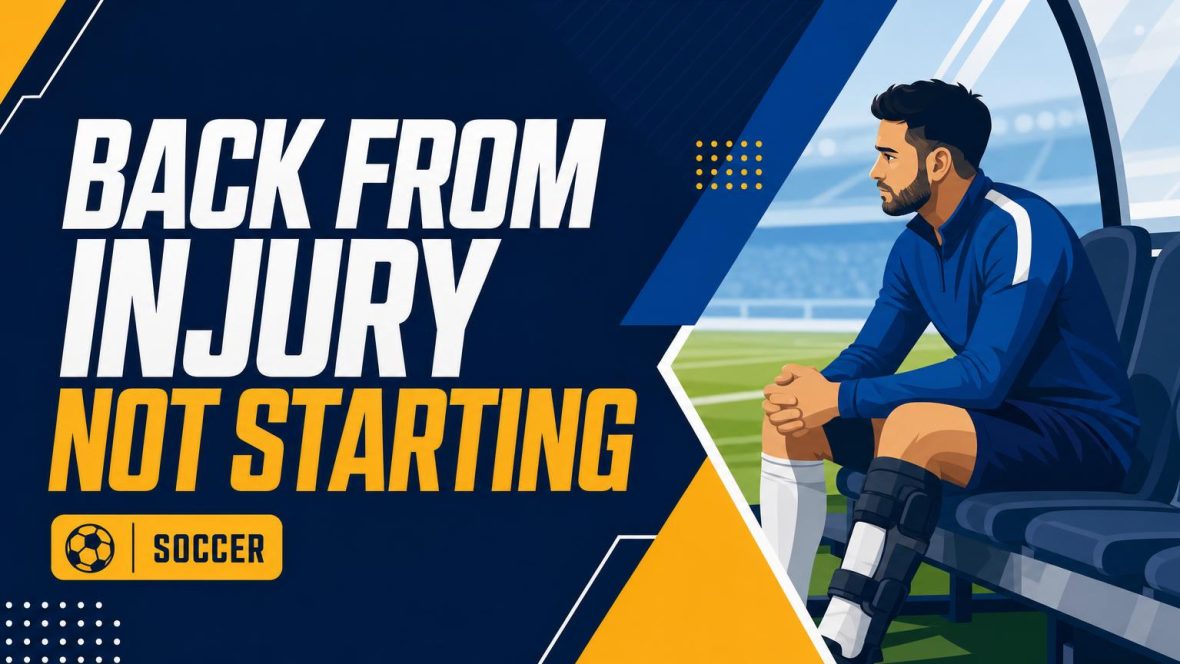
A place on the bench can look like a green light, but it is often only the final stage of rehabilitation.
The team sheet appears, the returning player’s name is there—and then the starting XI is announced without it. After days of “back in training” updates, that decision can feel baffling, especially when the match matters.
Top Free Bets for October
BetUS
200% up to $1,000
18+. Full T&C's apply. Sports bonus: 100% match up to $500. Casino bonus: 100% match up to $500. Enter promo code NEW200 at deposit and get up to a $1000 bonus. Valid on your first three (3) deposits. Available for all deposit methods. Minimum deposit of $50.
18+. Full terms apply. The Bet Back Bonus is available for new customers on first-time deposits of $50 or more. To redeem, select the offer in the cashier while completing your first deposit. Make your pick(s) in the Sportsbook and then select ‘Opt In to Use Your Bonus’. A Bet Back Bonus pop-up will display, select ‘Claim’ and then enter the risk amount to place your bet. If it wins, you keep your profits. If it loses, get 100% of your risk refunded as Free Play with only 1-time rollover. Free Play can then be used to place bets in the Sportsbook and earn cash. Additional T&Cs apply, please visit MyBookie to access the Help Center or contact Live Chat for more details.
18+. Full T&C's apply. This promotion is available only to new accounts in North America. Freeplay amount must be wagered five times (5x rollover) before it becomes eligible for withdrawal. Only prematch (sportsbook) bets count toward the 5x rollover requirement. Each person may claim only one bonus. If a customer creates multiple accounts to exploit this promotion, bet105 will mark all related accounts as ineligible and reclaim the funds. If a client receives more than two free bets without making a deposit, any winnings from those bets will be forfeited. This promotion applies only to the initial deposit or if specifically assigned by bet105.
18+. Full terms apply. New BUSR members only. Minimum deposit of $50 required per qualifying deposits. Codes 300SB1, 300SB2, and 300SB3 must be entered at the time of each corresponding deposit.
Each code is valid one time only. Each bonus code must be claimed at least 24 hours apart. Only one promo code may be applied per deposit. A 20x rollover requirement applies to the combined total of your initial deposit and bonus before any withdrawal can be made. Redeemable in the Sportsbook only. BUSR management reserves the right to modify, suspend, or cancel this promotion at any time. Redeem each promo code in the cashier to get your bonus. Must be 18 or older. Please gamble responsibly. General House Rules Apply.
18+. Full terms apply. 100% up to $500 Bonus. Valid for non-crypto payment methods only. Minimum deposit amount $50. This offer is not available to customers from Canada or Mexico. The bonus code must be redeemed immediately after the deposit and before a wager has been placed. The sum of the deposit and the bonus are subject to rollover requirements of 12x at min. odds of -200 (1.5) before a new code can be redeemed. Max. $500 of each bet count towards the rollover requirements. Only bets placed on options that take place count towards the rollover requirements. Wagers on Horse Racing and Boosted Odds do not count towards the rollover requirements. All general Everygame Sportsbook rules apply.
21+. Full T&C's apply. Bonus: 35% of qualifying deposit, up to $105. Rollover: 8× (only sports action counts towards the rollover) deposit + bonus. Expiry: 7 days after credit. Hold period: 2 weeks. Payouts allowed only after rollover and hold period are completed. Example: Deposit $200 → Receive $50 Sports Free Play. Sports Free Play Rules: see the BetAnything General Reward Rules for eligible sports, wager types, odds, and rollover rules.
18+. Full T&C's apply. This bonus can only be redeemed on your first deposit. Rollover is 5x Sports/5x Horses/30x Casino on both the initial deposit and the bonus amount. Rollover in our Sportsbook, for winning wagers, will be determined by the lesser of your risk or win amount at the time of wager settlement; for losing wagers your risk amount will be credited to your rollover contribution. Bonus funds cannot be used for play on Live Dealer games. Live Dealer play does not count toward meeting Casino rollover requirements for withdrawal. If a withdrawal is made before the bonus terms are met, all bonus funds as well as any money earned by wagering the bonus will be forfeited.
But available is not the same as ready for 90 minutes. A player may be medically cleared to take part while still rebuilding match sharpness, confidence in the injured area, or the ability to repeat sprints under pressure. Training can test movement and fitness, yet it cannot perfectly reproduce tackles, fatigue, and unpredictable match situations. Naming the player among the substitutes gives the coach a controlled option: perhaps 15–30 minutes, only if the game suits it, with less risk than starting and needing an early substitution. The bench, in that sense, is not proof that recovery is complete—it is often a carefully managed step toward it.
Different thresholds
Cleared does not mean ready to start
Selection demands more than healed tissue
Medical clearance usually means the injury has healed enough for football activity and the remaining risk is considered acceptable. It does not certify that the player can already perform at full competitive intensity. This distinction also helps explain the different timelines covered in a broader guide to football injuries and player absences.
The performance gap
Before starting, a player may still need to rebuild several capacities:
Conditioning: sustaining useful movement across a full match.
Repeat-sprint ability: recovering quickly enough to make another intense run.
Strength symmetry: reducing meaningful deficits between the injured and uninjured sides.
Load tolerance: handling several demanding training sessions without pain, swelling, or unusual fatigue.
These qualities are difficult to reproduce through rehabilitation alone. A player may look sharp in controlled drills yet fade when training becomes unpredictable, contact-heavy, or tactically demanding.
Clearance therefore makes the player eligible for selection; it does not guarantee a place in the lineup. Coaches may prefer substitute appearances and carefully increased minutes until training data, physical testing, and recovery responses suggest that starting is sensible. The decision reflects performance readiness as well as medical safety.
Return pathway
The match is the final test
Training builds capacity, but competition exposes what remains.
Why training has limits
Even intense sessions are more predictable than a competitive match. Drills can rehearse sprinting, turning, tackling, and ball work, but they cannot fully recreate an opponent’s movement, an awkward collision, or the need to make the right decision in a fraction of a second.
Competitive pressure also changes how effort is distributed. A player may react more sharply, cover an unexpected run, or enter contact without the control available in training. The issue is not simply fitness; it is whether the body and mind can handle repeated, unscripted actions at match speed.
The delayed evidence
Clubs assess more than the minutes played. Staff watch movement quality, fatigue, discomfort, and whether performance drops during the appearance, then check the response over the following 24–48 hours. Swelling, stiffness, pain, sleep, and test results can all affect the next step.
This is one of the common reasons projected injury return dates can move. A cautious estimate, another bench appearance, or fewer minutes than expected may reflect normal load management rather than a setback.
Typical progression
How match exposure is rebuilt
01
Partial team training
The player joins selected drills while avoiding the highest-risk contact or workload.
02
Full training
Normal sessions test sharper movement, decision-making, and repeated effort.
03
Bench selection
Availability provides flexibility, but an appearance may depend on the match situation.
04
Controlled minutes
A short cameo introduces genuine pace and pressure without demanding a full match load.
05
Longer appearances
Minutes increase only when both the performance and the next-day response are acceptable.
Progress is rarely perfectly linear; the plan may pause or repeat a stage without indicating renewed injury.
Selection is not a fixed promise
Being named among the substitutes shows that some match exposure is considered possible. It does not guarantee minutes, a start in the next fixture, or an unchanged recovery schedule.
Minutes matter
Why a short cameo proves little
Starting tests movement quality under sustained fatigue, not just early sharpness.
A player can look quick and comfortable for 15 minutes yet still be unprepared for an hour or more. The missing test is not simply extra running; it is whether efficient movement can be maintained as fatigue accumulates.
Tired players may shorten their stride, lose coordination, brake less cleanly, or rely more heavily on the uninjured side. Those changes are difficult to spot from the stands, but they matter after muscle injuries. For someone recovering from a football hamstring injury, repeated sprints late in a match may create a different concern from one or two fresh efforts.
A substitute appearance gives the staff unusually precise control over exposure:
the entry time sets a clear maximum workload;
the player can warm up immediately beforehand;
sprinting, accelerations, and decelerations can be reviewed afterward;
the player can be removed without disrupting the original match plan.
Starting is less predictable. An early injury to a teammate, extra time, or a high-tempo contest may turn a planned 60 minutes into a much heavier demand. Several successful cameos therefore provide useful evidence, but not an automatic case for selection from kickoff.
Team selection
Available does not mean selected
The best starter for one fixture may still be someone else.
Medical availability puts a player into contention; it does not automatically make that player the strongest choice for a particular match. An in-form replacement may deserve to keep the role, especially if that player has built rhythm and understanding with nearby teammates.
Missing training can matter even after fitness returns. A player who sat out tactical sessions may be less familiar with the week’s pressing triggers, set-piece duties, or planned movements against a specific opponent.
The position and formation also shape the decision. A returning winger might suit a 4-3-3 but have no natural role in a narrow midfield, while a defender may be cleared physically yet not preferred for a match requiring frequent recovery runs or aggressive pressing.
Selection can also reflect the expected game state:
Against a strong opponent, defensive reliability may take priority.
When possession is expected, sharper combinations may be valued.
If the match could open late, the returning player may be more useful from the bench.
A substitute role can therefore be tactical rather than cautious. It gives the coach an option to change tempo, protect a lead, chase a goal, or replace a tiring starter. Being fit enough to play and being the best opening choice are separate judgments.
Reading the signs
Which signals show a start is getting closer?
What does repeated squad inclusion suggest?
Regular selection usually means the player is tolerating the weekly routine and remains part of the manager’s plans. It is more meaningful than a single return to the bench, though it does not guarantee a start.
Do increasing substitute minutes matter?
A rise from brief cameos to longer appearances is one of the clearest signs of progress. The trend shows that staff are gradually trusting the player with more competitive load.
How significant is full training?
Full sessions indicate progress, especially when completed repeatedly without a setback. One training photo or social post reveals little about intensity, contact work, or whether the entire session was completed.
Why might the player start a lower-stakes match first?
A cup tie, reserve fixture, or less demanding matchup can provide controlled minutes from kickoff. Such starts help rebuild pacing and concentration without immediately adding the pressure of a major league fixture.
What does “building rhythm” usually mean?
It often refers to restoring timing, sharpness, and comfort through repeated match exposure. The phrase is vague on its own, so it carries more weight when substitute minutes and training loads are also increasing.
Follow the workload, then the teamsheet
A practical evidence order is: official lineup, recent match minutes, repeated squad selection, full training, then public comments. Photos and broad labels such as “fit” sit near the bottom.
Only the confirmed teamsheet settles the question—and explains how lineup announcements can shift the odds.
Reading the signs
When a start becomes likely
Full training is sustained
Several complete team sessions suggest the player can handle normal drills, contact, and tactical work.
Competitive minutes keep rising
Successive appearances with heavier workloads provide better evidence than one encouraging cameo.
There is no delayed reaction
No pain, swelling, or reduced training in the following 24–48 hours supports further progression.
The schedule allows recovery
A reasonable gap between fixtures makes a start less risky than a congested turnaround.
The tactics create an opening
The player’s role, opponent, formation, or a teammate’s absence may strengthen the selection case.
Specialists raise no recurrence concern
An imminent start looks more plausible when medical staff have not flagged renewed vulnerability.
Conclusion
An imminent start is a probability judgment, not a status update. Clearance, fitness, sharpness, risk management, and selection are separate hurdles; passing one does not guarantee the next.
When most of these signals align, a start becomes reasonable to expect. Only the announced starting XI makes it certain.
Top Free Bets for October
BetUS
200% up to $1,000
18+. Full T&C's apply. Sports bonus: 100% match up to $500. Casino bonus: 100% match up to $500. Enter promo code NEW200 at deposit and get up to a $1000 bonus. Valid on your first three (3) deposits. Available for all deposit methods. Minimum deposit of $50.
18+. Full terms apply. The Bet Back Bonus is available for new customers on first-time deposits of $50 or more. To redeem, select the offer in the cashier while completing your first deposit. Make your pick(s) in the Sportsbook and then select ‘Opt In to Use Your Bonus’. A Bet Back Bonus pop-up will display, select ‘Claim’ and then enter the risk amount to place your bet. If it wins, you keep your profits. If it loses, get 100% of your risk refunded as Free Play with only 1-time rollover. Free Play can then be used to place bets in the Sportsbook and earn cash. Additional T&Cs apply, please visit MyBookie to access the Help Center or contact Live Chat for more details.
18+. Full T&C's apply. This promotion is available only to new accounts in North America. Freeplay amount must be wagered five times (5x rollover) before it becomes eligible for withdrawal. Only prematch (sportsbook) bets count toward the 5x rollover requirement. Each person may claim only one bonus. If a customer creates multiple accounts to exploit this promotion, bet105 will mark all related accounts as ineligible and reclaim the funds. If a client receives more than two free bets without making a deposit, any winnings from those bets will be forfeited. This promotion applies only to the initial deposit or if specifically assigned by bet105.
18+. Full terms apply. New BUSR members only. Minimum deposit of $50 required per qualifying deposits. Codes 300SB1, 300SB2, and 300SB3 must be entered at the time of each corresponding deposit.
Each code is valid one time only. Each bonus code must be claimed at least 24 hours apart. Only one promo code may be applied per deposit. A 20x rollover requirement applies to the combined total of your initial deposit and bonus before any withdrawal can be made. Redeemable in the Sportsbook only. BUSR management reserves the right to modify, suspend, or cancel this promotion at any time. Redeem each promo code in the cashier to get your bonus. Must be 18 or older. Please gamble responsibly. General House Rules Apply.
18+. Full terms apply. 100% up to $500 Bonus. Valid for non-crypto payment methods only. Minimum deposit amount $50. This offer is not available to customers from Canada or Mexico. The bonus code must be redeemed immediately after the deposit and before a wager has been placed. The sum of the deposit and the bonus are subject to rollover requirements of 12x at min. odds of -200 (1.5) before a new code can be redeemed. Max. $500 of each bet count towards the rollover requirements. Only bets placed on options that take place count towards the rollover requirements. Wagers on Horse Racing and Boosted Odds do not count towards the rollover requirements. All general Everygame Sportsbook rules apply.
21+. Full T&C's apply. Bonus: 35% of qualifying deposit, up to $105. Rollover: 8× (only sports action counts towards the rollover) deposit + bonus. Expiry: 7 days after credit. Hold period: 2 weeks. Payouts allowed only after rollover and hold period are completed. Example: Deposit $200 → Receive $50 Sports Free Play. Sports Free Play Rules: see the BetAnything General Reward Rules for eligible sports, wager types, odds, and rollover rules.
18+. Full T&C's apply. This bonus can only be redeemed on your first deposit. Rollover is 5x Sports/5x Horses/30x Casino on both the initial deposit and the bonus amount. Rollover in our Sportsbook, for winning wagers, will be determined by the lesser of your risk or win amount at the time of wager settlement; for losing wagers your risk amount will be credited to your rollover contribution. Bonus funds cannot be used for play on Live Dealer games. Live Dealer play does not count toward meeting Casino rollover requirements for withdrawal. If a withdrawal is made before the bonus terms are met, all bonus funds as well as any money earned by wagering the bonus will be forfeited.
Hi I'm Andy and I love to report on the latest football scores and Tables. I also like to have a bet on the football and occasionaly on the horses. On this website I have new bookmaker offers listed that will give you free bets and bonuses to help you beat the bookies. Enjoy your stay.