


BetWhale
125% Sports Bonus + $25 Free Chip
SWIFTNESS: minimum deposit is $30, 10x WG, no max CO
LOYALTY: 50x WG, 5x max CO 18+. Full T&C's apply.

A formation is a snapshot; the match is the moving picture.
The team sheet says 4-3-3, but the opening whistle quickly makes that label look unreliable. One full-back races beyond the winger, the other stays beside the centre-backs, and the holding midfielder drops toward them. In possession, the shape may resemble a 3-2-5; when the ball is lost, the wingers retreat and it can settle into a 4-5-1.




The numbers describe starting reference points, not fixed parking spaces. Roles and instructions provide the missing meaning: a winger might hug the touchline or cut inside, while a striker might lead the line or drop into midfield. Pressing triggers and marking duties alter the picture again. The label becomes useful shorthand only when paired with each player’s job.
A formation such as 4-2-3-1 counts outfield players from defense to attack: four defenders, two deeper midfielders, three advanced midfielders, and one striker. The goalkeeper is omitted because every standard lineup already has one; including that fixed position would add little useful information.
A back four means the nominal defensive line has four players. A double pivot is a pair of central midfielders in front of that defense, while a front three usually places two wide forwards around a central attacker. These labels describe starting reference points, not permanent positions.
Broadcast graphics arrange players neatly, but movement soon changes the picture. For a practical method of identifying formations, scan from the goalkeeper outward during settled play:
Repeated positions matter more than one freeze-frame; a full-back pressing high is not automatically a winger.
Position vs. role
A position marks the starting zone; a role describes the expected behavior. Two teams using 4-3-3 can therefore attack and defend very differently.
Defensive roles
Center-backs protect central space, while fullbacks usually begin wider. The difference between fullbacks and wing-backs lies mainly in attacking freedom, height, and defensive cover.
Midfield roles
A holding midfielder screens the defense, a playmaker organizes possession, and a box-to-box player covers ground. An inverted fullback moving into midfield can add another central player.
Wide roles
A winger holds width or attacks behind; an inverted winger cuts inside. An overlapping defender can then occupy the space outside.
Forward roles
Strikers may finish, hold up play, or stretch the back line with runs behind. A false nine dropping away from center-backs instead creates space for teammates to enter.
Each shape creates different connections, but none supplies an automatic style. Player roles, spacing, and movement decide what the numbers become.
A formation can support a high press, patient possession, or a low block. Execution makes it attacking, defensive, balanced—or ineffective.
Two teams using the same formation may look completely different. Watch line height, player spacing, pressing triggers, and forward runs.
Both the 3-4-3 and 3-5-2 exchange a midfielder or forward for a third center-back. That spare defender can offer a safer passing angle in buildup, cover teammates who step out, and protect the middle when possession is lost.
Width then comes mainly from the wing-backs. In a 3-4-3, they support a front three, while two central midfielders must cover considerable ground. In a 3-5-2, the extra central midfielder improves compactness and can connect play behind two strikers; the strengths and weaknesses of advancing both wing-backs become especially clear during turnovers.
The tradeoff appears outside the back three. Opponents can attack the channels behind advanced wing-backs, pulling the wide center-backs away from goal. Dropping into a back five reduces that space but can leave the strikers isolated.
Wing-backs therefore need stamina, speed, sound positioning, and reliable delivery. Teams often protect them by shifting a midfielder across, keeping one wing-back deeper, or asking the nearest forward to press the opposing full-back.
A 4-3-3 is usually a starting reference, not a shape preserved for 90 minutes. As possession changes, players move to create passing options, occupy dangerous spaces, or protect routes toward their own goal.
In early possession, one full-back may advance while the other stays beside the center-backs. A midfielder drops close to receive, producing a 3-2 buildup shape. The back three spread the first line, while the two central options help play through pressure.
This movement can create a local numerical advantage—one example of how an overload is created. Its value depends on spacing: several players standing close together may add numbers without adding useful passing angles.
Once the ball advances, the same side may resemble a 2-3-5. Two defenders remain behind the play; three players support underneath; and five occupy the forward line, often filling both wings, both inside channels, and the center.
That width stretches defenders, but it also demands rest defense: players positioned to slow or stop a counterattack. If too many join the attack, one lost pass can expose the two remaining defenders.
After possession is lost, immediate pressure may delay the opponent while teammates retreat. The distinction between attacking and defensive transitions is clearest here: one turnover changes every player’s priority.
If the ball cannot be regained, the wingers may drop alongside the midfielders, turning the original 4-3-3 into a compact 4-5-1. Formation is therefore best read as a repeating cycle of shapes.
A formation describes starting relationships, not where defending begins. The same 4-3-3 can press near the opposition box, settle into a midfield block, or retreat deep. Understanding how a high press stays protected means looking beyond the front three.
The defensive line may also sit high or low independently of the nominal shape. A high line compresses the space behind the press, helping midfielders challenge second balls. However, the danger of raising the back line grows sharply when the ball carrier has time to pass behind it.
An aggressive setup is most secure when:
Simply pushing players forward is not pressing. One late movement can open a passing lane, while an unpressured passer can defeat several lines at once. Even a well-timed offside trap depends on collective movement and pressure ahead of the defense.
A high block compresses play near the opponent’s goal, but leaves space behind if pressure on the ball fails. A mid block protects central areas around halfway and invites buildup before pressing; the risk balance between mid and low blocks depends on how quickly the lines shift.
A deeper, compact low block limits runs behind, yet can concede space for shots, cutbacks, and second balls. Extra defenders are not enough if they merely retreat and leave passing lanes open.
Marking duties shape each block’s stability. Zonal defenders protect spaces and pass runners on; man-oriented defenders follow opponents more closely, potentially opening gaps. The weak points of both marking approaches show why the same eleven players can defend aggressively, cautiously, or poorly without changing formation.
The spare midfielder matters only if teammates can find and support that player.
Pressing angles, roles, and distances decide whether the apparent advantage exists. This is central to reading tactical matchups.
Extra defenders can leave fewer passing options ahead and invite sustained pressure.
Safety depends on outlets, compact support, and the ability to escape an aggressive press.
Wide positioning can stretch defenders and open central gaps without producing a cross.
Switches, cutbacks, and underlapping runs often provide better ways to unpick a compact low block.
During a settled phase, locate the back line, central midfielders, widest players, and highest forward.
Recheck those positions after possession changes. Match-day tactics apps can help record recurring shifts.
Watch movements rather than the ball alone. More detailed tactics books can clarify unfamiliar role patterns.
Draw the team in and out of possession; simple formation-making tools keep the comparison clear.
State the base formation, decisive roles, main benefit, and matching risk. Structured tactics courses can refine this habit.
Reliable formation reading comes from repeated observation, not one freeze-frame. Identify the shape, explain the key movement, then connect its advantage to the space or duty it exposes.

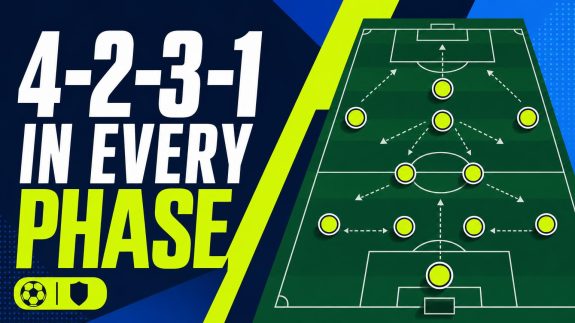
A 4-2-3-1 is best read as a set of starting relationships, not ten fixed outfield…
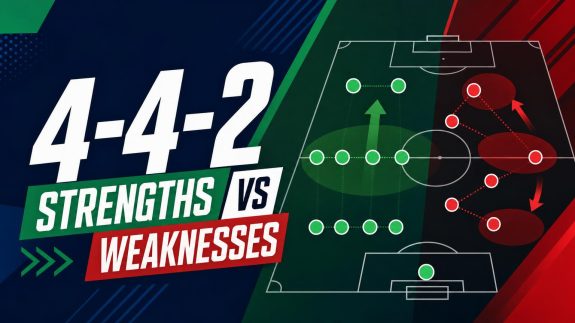
4-4-2 is best read as a starting reference, not a screenshot that remains unchanged. The…