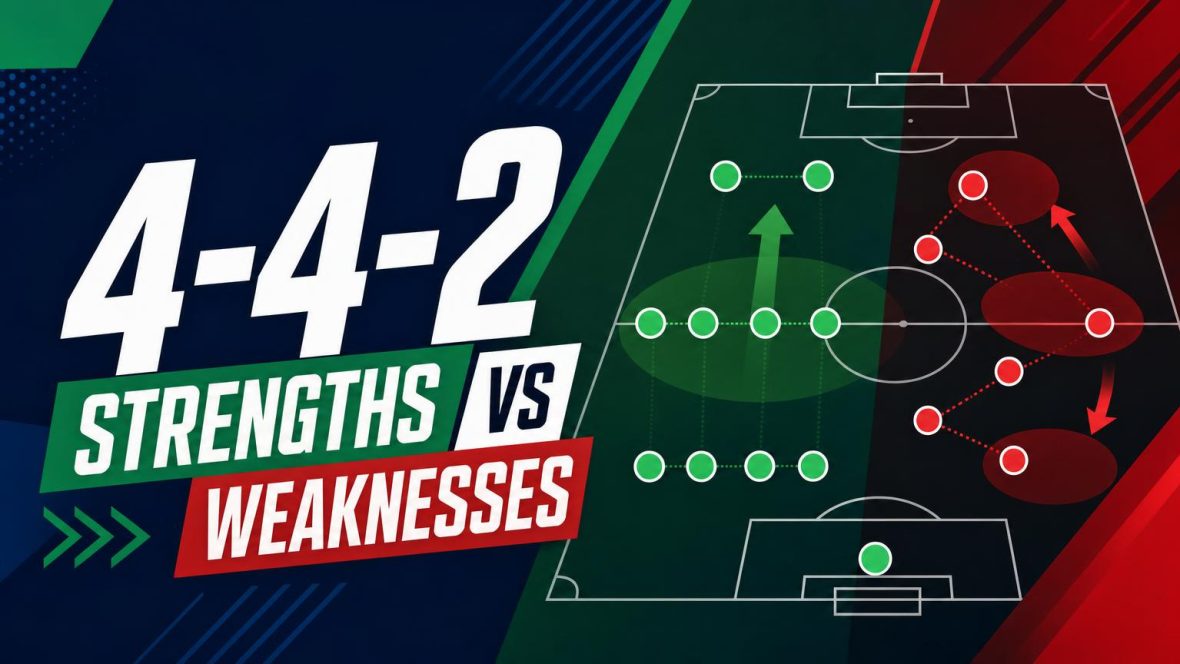
The 4-4-2 is simple to recognise—but increasingly difficult to keep intact.
A routine buildup can expose the central problem within seconds. The two 4-4-2 midfielders step forward, an opposing full-back slips inside, and suddenly they are chasing a three-against-two. If the ball goes wide, an aggressive press can pin the full-back while runners attack the gap behind the winger.
Top Free Bets for October
BetUS
200% up to $1,000
18+. Full T&C's apply. Sports bonus: 100% match up to $500. Casino bonus: 100% match up to $500. Enter promo code NEW200 at deposit and get up to a $1000 bonus. Valid on your first three (3) deposits. Available for all deposit methods. Minimum deposit of $50.
18+. Full terms apply. The Bet Back Bonus is available for new customers on first-time deposits of $50 or more. To redeem, select the offer in the cashier while completing your first deposit. Make your pick(s) in the Sportsbook and then select ‘Opt In to Use Your Bonus’. A Bet Back Bonus pop-up will display, select ‘Claim’ and then enter the risk amount to place your bet. If it wins, you keep your profits. If it loses, get 100% of your risk refunded as Free Play with only 1-time rollover. Free Play can then be used to place bets in the Sportsbook and earn cash. Additional T&Cs apply, please visit MyBookie to access the Help Center or contact Live Chat for more details.
18+. Full T&C's apply. This promotion is available only to new accounts in North America. Freeplay amount must be wagered five times (5x rollover) before it becomes eligible for withdrawal. Only prematch (sportsbook) bets count toward the 5x rollover requirement. Each person may claim only one bonus. If a customer creates multiple accounts to exploit this promotion, bet105 will mark all related accounts as ineligible and reclaim the funds. If a client receives more than two free bets without making a deposit, any winnings from those bets will be forfeited. This promotion applies only to the initial deposit or if specifically assigned by bet105.
18+. Full terms apply. New BUSR members only. Minimum deposit of $50 required per qualifying deposits. Codes 300SB1, 300SB2, and 300SB3 must be entered at the time of each corresponding deposit.
Each code is valid one time only. Each bonus code must be claimed at least 24 hours apart. Only one promo code may be applied per deposit. A 20x rollover requirement applies to the combined total of your initial deposit and bonus before any withdrawal can be made. Redeemable in the Sportsbook only. BUSR management reserves the right to modify, suspend, or cancel this promotion at any time. Redeem each promo code in the cashier to get your bonus. Must be 18 or older. Please gamble responsibly. General House Rules Apply.
18+. Full terms apply. 100% up to $500 Bonus. Valid for non-crypto payment methods only. Minimum deposit amount $50. This offer is not available to customers from Canada or Mexico. The bonus code must be redeemed immediately after the deposit and before a wager has been placed. The sum of the deposit and the bonus are subject to rollover requirements of 12x at min. odds of -200 (1.5) before a new code can be redeemed. Max. $500 of each bet count towards the rollover requirements. Only bets placed on options that take place count towards the rollover requirements. Wagers on Horse Racing and Boosted Odds do not count towards the rollover requirements. All general Everygame Sportsbook rules apply.
21+. Full T&C's apply. Bonus: 35% of qualifying deposit, up to $105. Rollover: 8× (only sports action counts towards the rollover) deposit + bonus. Expiry: 7 days after credit. Hold period: 2 weeks. Payouts allowed only after rollover and hold period are completed. Example: Deposit $200 → Receive $50 Sports Free Play. Sports Free Play Rules: see the BetAnything General Reward Rules for eligible sports, wager types, odds, and rollover rules.
18+. Full T&C's apply. This bonus can only be redeemed on your first deposit. Rollover is 5x Sports/5x Horses/30x Casino on both the initial deposit and the bonus amount. Rollover in our Sportsbook, for winning wagers, will be determined by the lesser of your risk or win amount at the time of wager settlement; for losing wagers your risk amount will be credited to your rollover contribution. Bonus funds cannot be used for play on Live Dealer games. Live Dealer play does not count toward meeting Casino rollover requirements for withdrawal. If a withdrawal is made before the bonus terms are met, all bonus funds as well as any money earned by wagering the bonus will be forfeited.
Yet the shape still offers clear reference points, natural width, and two forwards ready to counter or press centre-backs. Its success is less about being old-fashioned than keeping the lines compact, moving together, and knowing when one striker should drop or a wide midfielder should narrow. Small adaptations can preserve the familiar balance; poor spacing makes it unravel quickly.
Beyond the diagram
A shape that moves
Player movement changes what 4-4-2 becomes in each phase.
4-4-2 is best read as a starting reference, not a screenshot that remains unchanged. The label describes where players broadly begin and how they may defend, while a wider guide to formations and tactical trade-offs places those choices alongside other systems.
When a full-back advances, the wide midfielder can move inside to support central possession. That may create a temporary 3-2-5 or 2-3-5 in attack, depending on what the opposite full-back does. If both full-backs stay cautious, the side retains a clearer back four but offers less width high up the pitch.
A striker can also drop between the lines, turning the front pair into something closer to a number 10 behind one forward. This supplies a short passing option and may draw out a centre-back, although it leaves fewer runners threatening the box.
Without the ball, wide midfielders usually recover beside the central pair to restore two compact banks of four. The practical question is therefore not simply whether a team “plays 4-4-2,” but who leaves the base shape, when they move, and who covers the space.
Why it endures
What keeps 4-4-2 practical
Clear responsibilities
Each player starts with an understandable reference point: centre-backs protect the middle, central midfielders screen and support, while wide pairs manage the flanks. That clarity can reduce hesitation when possession changes hands.
Balanced coverage
Two compact banks cover the width and depth of the pitch without requiring constant positional rotation. If the lines shift together, opponents are often pushed toward wider areas where pressing traps are easier to set.
Two forward outlets
Keeping two players high gives defenders and midfielders immediate targets after regaining the ball. One striker can contest a direct pass while the other attacks space, combines underneath, or occupies the spare centre-back.
Nearby support
Natural partnerships appear across the shape: full-back and winger, central midfielder and striker, or the two forwards together. Short passing and covering distances make simple combinations repeatable, especially during quick transitions.
Control is not only possession
A 4-4-2 side may see less of the ball yet still influence where the match is played. Compact spacing can deny central passes, invite predictable circulation outside, and create direct counterattacking routes.
The shape becomes vulnerable when those distances stretch. Its strength comes less from the formation on paper than from players moving together and understanding who presses, covers, and provides the next pass.
Where the shape starts to strain
Some weaknesses come with the formation; others come from how poorly it moves.
A basic 4-4-2 places only two central midfielders against systems using a midfield three, an inverted full-back, or a striker dropping between the lines. That numerical disadvantage is an inherent tradeoff: protecting the centre often requires a striker or wide midfielder to narrow inside, which concedes easier possession elsewhere.
The common pressure points
Central overloads: Opponents can create a free player behind the strikers or around the midfield pair. If one midfielder steps out, space opens behind him.
Disconnected lines: A large gap between the forwards, midfield, and defence gives playmakers room to receive and turn. This is usually a compactness failure, not an unavoidable flaw in 4-4-2.
Pinned wide midfielders: Attacking full-backs can force the wide players deep, turning the shape into something close to a back six. The strikers then become isolated and counterattacks lose support.
Physical strain: Wide midfielders must track runners, help centrally, and still advance in transition. Central midfielders also cover substantial lateral ground, especially when pressing is bypassed.
Coordination determines whether these pressures become decisive. One player pressing alone stretches the block; a full-back advancing without cover exposes the channel; both strikers staying high can leave midfield outnumbered.
The formation cannot remove every overload without surrendering width or counterattacking presence. It can, however, avoid making those compromises worse through short distances, clear pressing cues, and synchronized shifts across the pitch.
The matchup
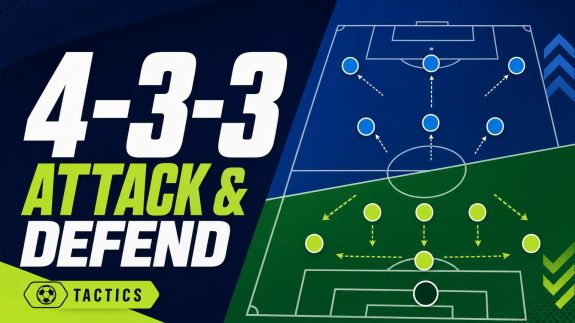
4-4-2 against a 4-3-3
Two forwards can disrupt the build-up, but the midfield three creates difficult choices behind them.
A 4-3-3 usually gives its centre-backs a spare passing option against two strikers, while its midfield three can outnumber the 4-4-2’s central pair. The trade-off is clear: 4-4-2 can threaten both centre-backs immediately, but may lose control behind that first press.
The angle matters
The two forwards should not simply charge straight ahead. One can press the ball-carrying centre-back from an angle that blocks the pass into the holding midfielder; the other stays close enough to discourage a switch across the back line. This curved approach is central to understanding how a 4-3-3 builds and circulates possession.
If the pressing angle is poor, the pivot receives freely and turns into the midfield overload. If it is correct, play is steered toward a full-back, where the touchline narrows the available options.
The wide midfielder’s dilemma
Once the ball travels wide, the 4-4-2 wide midfielder faces an awkward choice:
Press the full-back: the nearest 4-3-3 interior may become free between the lines.
Tuck inside: the full-back gains time to advance or combine with the winger.
The safest response is coordinated movement rather than one player covering both threats. As the wide midfielder presses outward, the central pair slides across and the far-side midfielder narrows. Done quickly, this preserves compactness; done late, it opens either the flank or the centre.
Key matchup
The No. 10 between the lines
Why a 4-2-3-1 forces difficult defensive choices
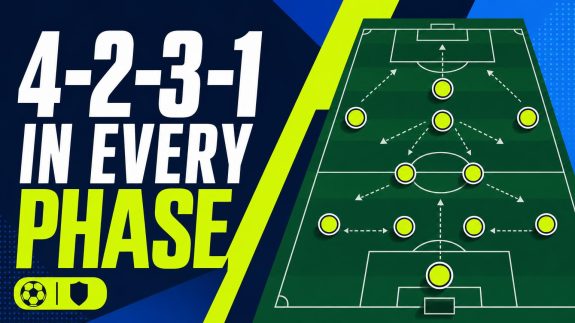
Against a 4-2-3-1, the central problem is often the No. 10 receiving behind the two central midfielders. If a centre-back steps forward, space opens for the lone striker or an inside-running winger. If a midfielder tracks back, the opponent’s double pivot gains time to circulate possession.
The safer answer is to compress the gap between midfield and defence. That denies clean turns, but it can push the 4-4-2 deeper and leave more room for full-backs outside. The wide midfielders then face longer recovery runs, especially after switches of play.
Another option is to alter one striker’s role, creating something closer to a 4-4-1-1 without the ball. The dropping striker can screen a pivot, block passes into the No. 10, or briefly follow that player into midfield. The cost is clear: fewer immediate outlets when possession is won.
A workable compromise keeps these duties situational:
Track only on a controlled first touch, rather than following the No. 10 everywhere.
Keep centre-backs in line unless pressure on the ball prevents a forward pass.
Leave one striker high, preferably the quicker runner, to protect the counterattacking threat.
The aim is not complete denial, but making the No. 10 receive facing away from goal.
System matchup
4-4-2 against a back three
The spare defender changes both the press and the counterattack
Against a 3-5-2, the first problem is numerical: three centre-backs can circulate around two strikers, leaving one defender free. Stepping a midfielder forward may remove that spare player, but it also opens space behind the midfield line. This is central to any attempt to compare 4-4-2 with a 3-5-2.
The pressure spreads elsewhere. Wing-backs can pin the wide midfielders deep, while three central midfielders move around the 4-4-2 pair. If the wide midfielders press forward, the wing-backs become available; if they stay back, the outside centre-backs can advance comfortably.
A useful pressing trigger is a pass into an outside centre-back. The near striker can curve the press to block the return pass, the wide midfielder can jump toward the wing-back, and the nearest central midfielder can screen the inside option. Timing matters: a late jump leaves both the wing-back and central midfielder free.
The trade-off is space behind advanced wing-backs. Quick passes into the channel can release a striker or wide midfielder before the back three shifts across. For 4-4-2, the best openings often come from forcing play wide, winning the next pass, and attacking that vacated flank immediately.
Targeted adaptations
Modern fixes without losing the shape
Small changes can solve specific matchups while keeping familiar partnerships intact.
Modern 4-4-2 rarely stays perfectly flat. Its useful adaptations change one relationship at a time rather than replacing the whole structure.
Drop one striker
Against a dominant pivot or a No. 10, one forward can withdraw into a 4-4-1-1. This adds a central screen and staggers the attack, while the higher striker still occupies the centre-backs. The deeper forward should remain close enough to support counters; dropping beside the central midfielders can leave the outlet isolated.
Press with four
A 4-2-4 press is usually a temporary pressing picture, not a permanent formation. Wide midfielders jump toward the full-backs while the strikers use curved runs to block passes into midfield. This can force rushed play wide, but only if the back six squeeze forward and preserve compact line distances.
Once possession is regained, staggered support offers safer routes through an opponent’s high press than four players running ahead at once.
Make one flank different
Asymmetric movement can address mismatched threats. One full-back may overlap while the opposite full-back stays deeper; one wide midfielder may tuck inside while the other holds width. These selective overlaps create an extra passing option without exposing both channels simultaneously.
The underlying references remain simple: one player advances, a nearby teammate covers, and the lines move together. The shape gains control through timing rather than added complexity.
Key principle
Adapt the relationship, not every role
If several players improvise at once, the adjustment becomes a new problem. Effective variations preserve cover, short support distances, and one clear counterattacking outlet.
Selection checklist
When 4-4-2 is a sensible choice
Check the central midfield pair
Both players need positional discipline, defensive range, and reliable passing under pressure. If neither can protect space alone, the lines must stay especially compact.
Assess the wide players
They must support full-backs without becoming permanent defenders, then offer an outlet when possession changes.
Match the strikers’ roles
The pairing works best when their movements complement each other: one can link or press while the other threatens depth.
Read the opponent’s central threat
Against three midfielders or a No. 10, plan who screens, tracks, and steps out. Leaving those decisions improvised makes overloads predictable.
Consider the match demand
4-4-2 suits direct transitions, crossing, and clear pressing references. It is less comfortable when prolonged central possession is essential.
Conclusion
4-4-2 remains useful when partnerships are strong, distances stay compact, and two forwards offer genuine counterattacking value. It becomes risky when wide recovery is unreliable or central overloads lack a rehearsed response.
The formation is therefore not inherently outdated or secure: its suitability depends on personnel, opponent, and match plan.
Top Free Bets for October
BetUS
200% up to $1,000
18+. Full T&C's apply. Sports bonus: 100% match up to $500. Casino bonus: 100% match up to $500. Enter promo code NEW200 at deposit and get up to a $1000 bonus. Valid on your first three (3) deposits. Available for all deposit methods. Minimum deposit of $50.
18+. Full terms apply. The Bet Back Bonus is available for new customers on first-time deposits of $50 or more. To redeem, select the offer in the cashier while completing your first deposit. Make your pick(s) in the Sportsbook and then select ‘Opt In to Use Your Bonus’. A Bet Back Bonus pop-up will display, select ‘Claim’ and then enter the risk amount to place your bet. If it wins, you keep your profits. If it loses, get 100% of your risk refunded as Free Play with only 1-time rollover. Free Play can then be used to place bets in the Sportsbook and earn cash. Additional T&Cs apply, please visit MyBookie to access the Help Center or contact Live Chat for more details.
18+. Full T&C's apply. This promotion is available only to new accounts in North America. Freeplay amount must be wagered five times (5x rollover) before it becomes eligible for withdrawal. Only prematch (sportsbook) bets count toward the 5x rollover requirement. Each person may claim only one bonus. If a customer creates multiple accounts to exploit this promotion, bet105 will mark all related accounts as ineligible and reclaim the funds. If a client receives more than two free bets without making a deposit, any winnings from those bets will be forfeited. This promotion applies only to the initial deposit or if specifically assigned by bet105.
18+. Full terms apply. New BUSR members only. Minimum deposit of $50 required per qualifying deposits. Codes 300SB1, 300SB2, and 300SB3 must be entered at the time of each corresponding deposit.
Each code is valid one time only. Each bonus code must be claimed at least 24 hours apart. Only one promo code may be applied per deposit. A 20x rollover requirement applies to the combined total of your initial deposit and bonus before any withdrawal can be made. Redeemable in the Sportsbook only. BUSR management reserves the right to modify, suspend, or cancel this promotion at any time. Redeem each promo code in the cashier to get your bonus. Must be 18 or older. Please gamble responsibly. General House Rules Apply.
18+. Full terms apply. 100% up to $500 Bonus. Valid for non-crypto payment methods only. Minimum deposit amount $50. This offer is not available to customers from Canada or Mexico. The bonus code must be redeemed immediately after the deposit and before a wager has been placed. The sum of the deposit and the bonus are subject to rollover requirements of 12x at min. odds of -200 (1.5) before a new code can be redeemed. Max. $500 of each bet count towards the rollover requirements. Only bets placed on options that take place count towards the rollover requirements. Wagers on Horse Racing and Boosted Odds do not count towards the rollover requirements. All general Everygame Sportsbook rules apply.
21+. Full T&C's apply. Bonus: 35% of qualifying deposit, up to $105. Rollover: 8× (only sports action counts towards the rollover) deposit + bonus. Expiry: 7 days after credit. Hold period: 2 weeks. Payouts allowed only after rollover and hold period are completed. Example: Deposit $200 → Receive $50 Sports Free Play. Sports Free Play Rules: see the BetAnything General Reward Rules for eligible sports, wager types, odds, and rollover rules.
18+. Full T&C's apply. This bonus can only be redeemed on your first deposit. Rollover is 5x Sports/5x Horses/30x Casino on both the initial deposit and the bonus amount. Rollover in our Sportsbook, for winning wagers, will be determined by the lesser of your risk or win amount at the time of wager settlement; for losing wagers your risk amount will be credited to your rollover contribution. Bonus funds cannot be used for play on Live Dealer games. Live Dealer play does not count toward meeting Casino rollover requirements for withdrawal. If a withdrawal is made before the bonus terms are met, all bonus funds as well as any money earned by wagering the bonus will be forfeited.
Hi I'm Andy and I love to report on the latest football scores and Tables. I also like to have a bet on the football and occasionaly on the horses. On this website I have new bookmaker offers listed that will give you free bets and bonuses to help you beat the bookies. Enjoy your stay.