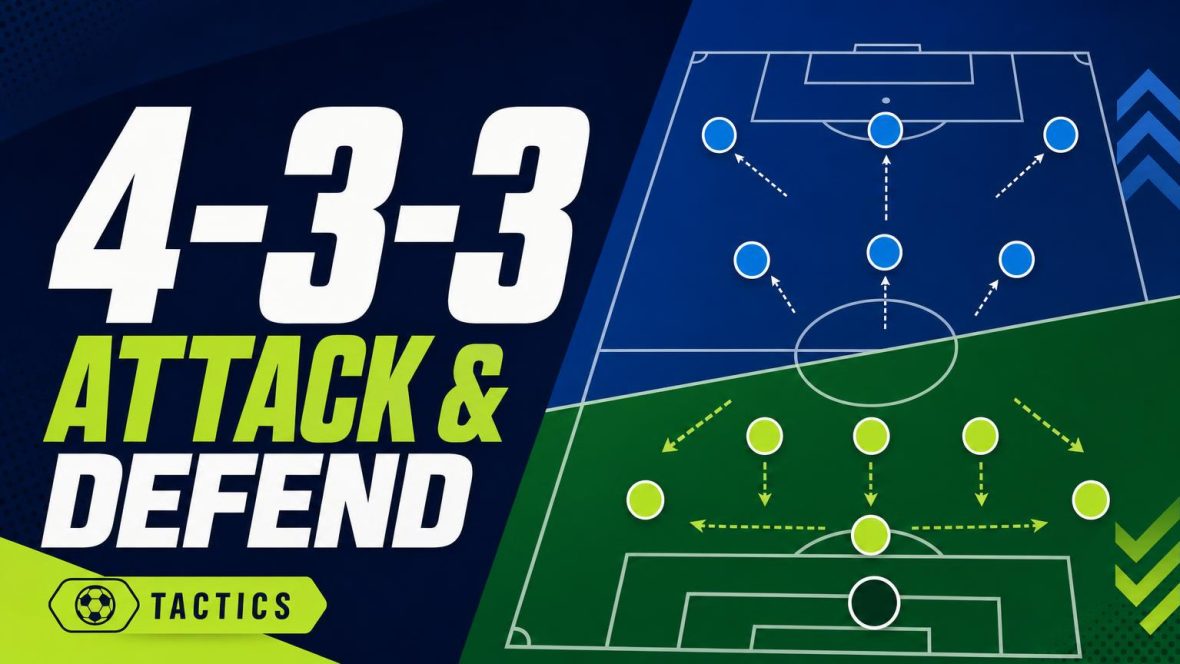
A formation is a starting position, not a freeze-frame.
At kickoff, the players may briefly form four defenders, three midfielders, and three forwards. Seconds later, a full-back pushes high, a winger moves inside, and the holding midfielder drops between the centre-backs. The apparent 4-3-3 has become something closer to a 3-2-5 or 2-3-5.
Top Free Bets for October
BetUS
200% up to $1,000
18+. Full T&C's apply. Sports bonus: 100% match up to $500. Casino bonus: 100% match up to $500. Enter promo code NEW200 at deposit and get up to a $1000 bonus. Valid on your first three (3) deposits. Available for all deposit methods. Minimum deposit of $50.
18+. Full terms apply. The Bet Back Bonus is available for new customers on first-time deposits of $50 or more. To redeem, select the offer in the cashier while completing your first deposit. Make your pick(s) in the Sportsbook and then select ‘Opt In to Use Your Bonus’. A Bet Back Bonus pop-up will display, select ‘Claim’ and then enter the risk amount to place your bet. If it wins, you keep your profits. If it loses, get 100% of your risk refunded as Free Play with only 1-time rollover. Free Play can then be used to place bets in the Sportsbook and earn cash. Additional T&Cs apply, please visit MyBookie to access the Help Center or contact Live Chat for more details.
18+. Full T&C's apply. This promotion is available only to new accounts in North America. Freeplay amount must be wagered five times (5x rollover) before it becomes eligible for withdrawal. Only prematch (sportsbook) bets count toward the 5x rollover requirement. Each person may claim only one bonus. If a customer creates multiple accounts to exploit this promotion, bet105 will mark all related accounts as ineligible and reclaim the funds. If a client receives more than two free bets without making a deposit, any winnings from those bets will be forfeited. This promotion applies only to the initial deposit or if specifically assigned by bet105.
18+. Full terms apply. New BUSR members only. Minimum deposit of $50 required per qualifying deposits. Codes 300SB1, 300SB2, and 300SB3 must be entered at the time of each corresponding deposit.
Each code is valid one time only. Each bonus code must be claimed at least 24 hours apart. Only one promo code may be applied per deposit. A 20x rollover requirement applies to the combined total of your initial deposit and bonus before any withdrawal can be made. Redeemable in the Sportsbook only. BUSR management reserves the right to modify, suspend, or cancel this promotion at any time. Redeem each promo code in the cashier to get your bonus. Must be 18 or older. Please gamble responsibly. General House Rules Apply.
18+. Full terms apply. 100% up to $500 Bonus. Valid for non-crypto payment methods only. Minimum deposit amount $50. This offer is not available to customers from Canada or Mexico. The bonus code must be redeemed immediately after the deposit and before a wager has been placed. The sum of the deposit and the bonus are subject to rollover requirements of 12x at min. odds of -200 (1.5) before a new code can be redeemed. Max. $500 of each bet count towards the rollover requirements. Only bets placed on options that take place count towards the rollover requirements. Wagers on Horse Racing and Boosted Odds do not count towards the rollover requirements. All general Everygame Sportsbook rules apply.
21+. Full T&C's apply. Bonus: 35% of qualifying deposit, up to $105. Rollover: 8× (only sports action counts towards the rollover) deposit + bonus. Expiry: 7 days after credit. Hold period: 2 weeks. Payouts allowed only after rollover and hold period are completed. Example: Deposit $200 → Receive $50 Sports Free Play. Sports Free Play Rules: see the BetAnything General Reward Rules for eligible sports, wager types, odds, and rollover rules.
18+. Full T&C's apply. This bonus can only be redeemed on your first deposit. Rollover is 5x Sports/5x Horses/30x Casino on both the initial deposit and the bonus amount. Rollover in our Sportsbook, for winning wagers, will be determined by the lesser of your risk or win amount at the time of wager settlement; for losing wagers your risk amount will be credited to your rollover contribution. Bonus funds cannot be used for play on Live Dealer games. Live Dealer play does not count toward meeting Casino rollover requirements for withdrawal. If a withdrawal is made before the bonus terms are met, all bonus funds as well as any money earned by wagering the bonus will be forfeited.
When possession is lost, those same players may recover into a 4-1-4-1, while a coordinated press can resemble a narrow front four. The useful question is therefore not simply “Where is each player?” but “Which space and responsibility is each player taking?” Width, cover, passing lanes, and pressure on the ball reveal the system more clearly than fixed rows do. The shape works only when movements connect: one player advancing usually requires another to balance behind.
The 4-3-3 starting shape
Eleven roles create clear central and wide reference points.
On the teamsheet, a 4-3-3 has four defenders, one holding midfielder, two more advanced central midfielders, two wingers and one striker. The holder—often called the six—sits behind the two eights, giving the midfield its familiar triangular arrangement.
The same geometry appears out wide. On either flank, the full-back, number eight and winger form a passing triangle, offering short diagonal options rather than a straight line up the touchline. The striker provides a central target, while the centre-backs and holding midfielder create another base for circulation.
These positions are reference points, not fixed spots. A winger may move inside as the full-back overlaps; an eight may drop beside the holder; the striker may come short to connect play. The shape remains useful because it clarifies where those movements begin.
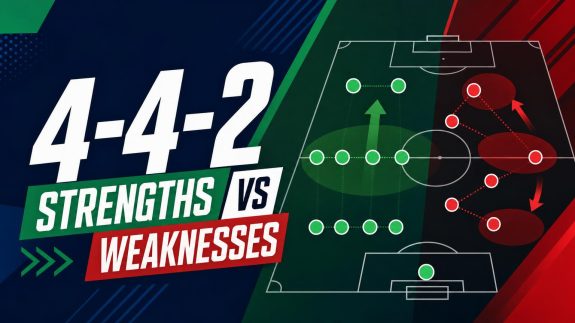
Among commonly explained football formations, 4-3-3 is distinguished by its single holder and two eights. A 4-2-3-1 instead starts with two deeper midfielders and a number ten, while a 4-1-4-1 may look similar defensively but places the wide players in a flatter midfield line.
Build-up
How the first line escapes pressure
01
Let the goalkeeper identify the spare player
Against one striker, the goalkeeper and two centre-backs usually create a free passer. Short circulation can draw that striker forward; if the press locks onto every nearby option, a clipped pass toward a fullback or winger may be safer than forcing play through the middle.
02
Use the centre-backs to provoke a decision
The centre-backs split wide and carry forward when no opponent commits. Once a presser steps out, the ball can move into the space that player has left, often through the holding midfielder or an eight dropping toward play.
03
Adjust the holder’s height
The holding midfielder normally stays ahead of the centre-backs, helping form a 2-3 base with the fullbacks. Against two pressing forwards, the holder can temporarily drop between or beside the centre-backs, creating a back three and a clearer route around the first line.
04
Change the fullbacks’ positions asymmetrically
Both fullbacks need not advance together. One may stay available outside while the other moves into midfield—the inverted fullback role—giving the ball carrier another central angle without leaving both flanks exposed.
05
Keep protection behind the escape
Beating the first press is only useful if possession remains secure. A centre-back, the holder, and often the far-side fullback should remain connected behind the ball, ready to collect a backward pass or slow a counter if the next pass is lost.
The preferred structure depends on how many players the opposition commits to the first press.
Midfield balance
How the six and eights share the midfield
Advanced movement works only when the centre remains protected.
In a 4-3-3, the number six normally starts behind the other midfielders, offering the centre-backs a central passing angle and screening passes into the striker. The six stays connected to the ball: sliding across when play moves wide, dropping toward the back line under pressure, or stepping forward for a loose clearance.
The number eights begin higher, often in the half-spaces. They can receive between opposition lines, run beyond a winger or rotate wide when a full-back moves inside. Their movement should stretch defenders without leaving the six isolated.
The key question is how many players can move ahead of the ball while possession remains secure. If both eights advance alongside high full-backs, the attack occupies more forward lanes—but one poor pass can expose a large central gap.
Useful balancing cues include:
When one eight runs beyond, the other can remain slightly deeper.
If a full-back attacks high, the nearby eight can protect the space behind.
The six should avoid being pulled toward the touchline unless a teammate covers the centre.
Effective midfield play therefore often looks asymmetrical: several players threaten forward while others form a safety net against the counterattack.
In possession
Stretching into five attacking lanes
Width and central movement turn the base shape into an attacking line
In sustained possession, the 4-3-3 often spreads across five vertical lanes: two wings, two half-spaces and the centre. A common front five places the wingers outside, the eights between fullback and centre-back, and the striker centrally. This spacing stretches the defensive line without leaving several attackers asking for the same pass.
Winger and fullback rotations
The winger-fullback relationship decides how each flank is occupied. If the winger holds the touchline, the fullback can support underneath or move into the half-space. If the winger cuts inside, the fullback usually overlaps to preserve width and prevent the defence from narrowing comfortably.
Both sides need not mirror each other. One flank might use an overlapping fullback and inverted winger, while the other keeps the winger wide and the fullback deeper to protect against counters. The nearby eight completes the triangle, offering a third-man pass or a run beyond the defence.
What happens when the striker moves
The striker can pin the centre-backs, threaten the space behind, drift toward one channel, or drop between the lines. Using a false nine to draw out the centre-backs can create a valuable gap, but only when another attacker recognises it.
The vacated centre should be attacked immediately by an inside winger, an advancing eight, or occasionally both on staggered runs. Typically, one runner attacks the near-side gap while the opposite winger arrives at the back post. Without those coordinated movements, the striker’s drop merely removes the team’s central target and allows the defence to step forward.
After possession
The first seconds after losing possession
Counterpressure buys time for the team to recover its shape.
A 4-3-3 cannot switch instantly from an expansive attack to a compact defensive block. The first reaction to a turnover therefore acts as a bridge: nearby players delay or disrupt the opponent while deeper teammates recover.
Dividing the work
A counterpress should be coordinated rather than an all-out chase:
The nearest player pressures the ball carrier, ideally forcing play toward the touchline or backwards.
The next two players block short passes and crowd the likely escape route.
The far-side winger and midfielders narrow inward, protecting central space rather than remaining in attacking positions.
The back line and holding midfielder judge whether to step up for an interception or retreat against a direct ball.
This only works when defensive cover has been arranged before possession is lost. If both fullbacks and both eights advance, the centre-backs may be left guarding a large area alone. A common safeguard is a deeper triangle formed by the two centre-backs and the six, sometimes reinforced by a tucked-in fullback.
If the first pressure is beaten cleanly, the press should be abandoned. Players then sprint goal-side and rebuild a compact block instead of continuing isolated challenges.
Pressure needs cover
Counterpressing is not simply about winning the ball back. Its immediate value is often slowing the counterattack long enough for advanced players to recover.
Without the ball
Steering play into pressing traps
The front three guide the ball; the midfield closes the escape routes.
A 4-3-3 press is rarely three forwards simply chasing defenders. The striker usually curves the first run to block a pass across the back line or into the holding midfielder. The ball-side winger then approaches from outside to inside, encouraging play toward the touchline, where fewer passing angles are available.
This steering is central to how an effective high press works. As the front line moves, the nearest eight pushes up behind it while the far-side eight narrows. Their job is to compress the space around likely receivers, not to follow every opponent.
Useful pressing triggers include:
a slow or bouncing pass toward a full-back;
a receiver facing their own goal;
a poor first touch or pass onto a weaker foot;
a backward pass that allows the team to step forward together.
The number six provides the balance. If a pass enters midfield and nearby teammates can trap the receiver, the six may step in aggressively. If the first line is bypassed or an opposing attacker occupies the space behind the eights, protecting the centre matters more than joining the chase.
That decision keeps the press connected. An over-eager six can leave centre-backs exposed to a direct pass; a passive six allows opponents to turn. The best cue is collective distance: step forward when support is close, hold when gaps are opening.
Defensive shape
The compact 4-1-4-1 block
Closing the centre without surrendering the counter
When sustained pressure is unavailable, the 4-3-3 commonly contracts into a 4-1-4-1. The wingers drop beside the eights, while the six holds the space between midfield and defence. Short distances between those lines deny passes into the striker or attacking midfielder.
The centre-forward guides circulation towards one side rather than chasing both centre-backs. Behind, the midfield four shuffle together, keeping the ball outside and waiting for a poor touch, backward pass or receiver facing their own goal. The far-side winger narrows to protect central space instead of staying attached to the opposing fullback.
This shape offers two useful outcomes:
Central security: five midfielders crowd the most direct routes to goal.
Counterattacking access: the striker, winger and nearest eight can break quickly once possession is recovered.
Its weak points appear when the unit loses connection. An eight stepping out can expose the channel beside the six; a fast switch can find the far-side fullback isolated against a winger and overlapping runner. Deep crosses and cutbacks also become dangerous if the back line is pinned.
The practical response is collective movement: the six slides towards the threatened channel, the far-side eight covers inside, and the winger recovers far enough to prevent a two-against-one. Compactness matters more than winning the ball immediately.
Match checklist
How to read a 4-3-3 in real time
Locate the width
Check whether wingers or fullbacks hold the touchlines. The choice reveals who can move inside and where overloads may form.
Count the build-up support
Note who joins the centre-backs and whether the goalkeeper, six or a fullback creates the spare player.
Watch the half-spaces
Track which eights, wingers or fullbacks occupy the channels between centre and flank—and whether they arrive at different heights.
Inspect the cover
When attacks develop, count the players protecting central counterattacking routes. A crowded box may hide a fragile structure behind it.
Identify genuine pressing cues
Look for coordinated movement after a back pass, poor touch or pass toward the sideline—not one forward chasing alone.
Find the concession
Every adjustment leaves something available: the far flank, space beside the six, a pass behind the fullback or easier circulation at the back.
Conclusion
The most revealing question is not where a player starts, but who replaces the space when that player moves.
A 4-3-3 works when its attacking spacing, transition cover and defensive pressure support one another. It is best understood as a coordinated sequence of shapes; the static team sheet shows only the starting reference.
Top Free Bets for October
BetUS
200% up to $1,000
18+. Full T&C's apply. Sports bonus: 100% match up to $500. Casino bonus: 100% match up to $500. Enter promo code NEW200 at deposit and get up to a $1000 bonus. Valid on your first three (3) deposits. Available for all deposit methods. Minimum deposit of $50.
18+. Full terms apply. The Bet Back Bonus is available for new customers on first-time deposits of $50 or more. To redeem, select the offer in the cashier while completing your first deposit. Make your pick(s) in the Sportsbook and then select ‘Opt In to Use Your Bonus’. A Bet Back Bonus pop-up will display, select ‘Claim’ and then enter the risk amount to place your bet. If it wins, you keep your profits. If it loses, get 100% of your risk refunded as Free Play with only 1-time rollover. Free Play can then be used to place bets in the Sportsbook and earn cash. Additional T&Cs apply, please visit MyBookie to access the Help Center or contact Live Chat for more details.
18+. Full T&C's apply. This promotion is available only to new accounts in North America. Freeplay amount must be wagered five times (5x rollover) before it becomes eligible for withdrawal. Only prematch (sportsbook) bets count toward the 5x rollover requirement. Each person may claim only one bonus. If a customer creates multiple accounts to exploit this promotion, bet105 will mark all related accounts as ineligible and reclaim the funds. If a client receives more than two free bets without making a deposit, any winnings from those bets will be forfeited. This promotion applies only to the initial deposit or if specifically assigned by bet105.
18+. Full terms apply. New BUSR members only. Minimum deposit of $50 required per qualifying deposits. Codes 300SB1, 300SB2, and 300SB3 must be entered at the time of each corresponding deposit.
Each code is valid one time only. Each bonus code must be claimed at least 24 hours apart. Only one promo code may be applied per deposit. A 20x rollover requirement applies to the combined total of your initial deposit and bonus before any withdrawal can be made. Redeemable in the Sportsbook only. BUSR management reserves the right to modify, suspend, or cancel this promotion at any time. Redeem each promo code in the cashier to get your bonus. Must be 18 or older. Please gamble responsibly. General House Rules Apply.
18+. Full terms apply. 100% up to $500 Bonus. Valid for non-crypto payment methods only. Minimum deposit amount $50. This offer is not available to customers from Canada or Mexico. The bonus code must be redeemed immediately after the deposit and before a wager has been placed. The sum of the deposit and the bonus are subject to rollover requirements of 12x at min. odds of -200 (1.5) before a new code can be redeemed. Max. $500 of each bet count towards the rollover requirements. Only bets placed on options that take place count towards the rollover requirements. Wagers on Horse Racing and Boosted Odds do not count towards the rollover requirements. All general Everygame Sportsbook rules apply.
21+. Full T&C's apply. Bonus: 35% of qualifying deposit, up to $105. Rollover: 8× (only sports action counts towards the rollover) deposit + bonus. Expiry: 7 days after credit. Hold period: 2 weeks. Payouts allowed only after rollover and hold period are completed. Example: Deposit $200 → Receive $50 Sports Free Play. Sports Free Play Rules: see the BetAnything General Reward Rules for eligible sports, wager types, odds, and rollover rules.
18+. Full T&C's apply. This bonus can only be redeemed on your first deposit. Rollover is 5x Sports/5x Horses/30x Casino on both the initial deposit and the bonus amount. Rollover in our Sportsbook, for winning wagers, will be determined by the lesser of your risk or win amount at the time of wager settlement; for losing wagers your risk amount will be credited to your rollover contribution. Bonus funds cannot be used for play on Live Dealer games. Live Dealer play does not count toward meeting Casino rollover requirements for withdrawal. If a withdrawal is made before the bonus terms are met, all bonus funds as well as any money earned by wagering the bonus will be forfeited.
Hi I'm Andy and I love to report on the latest football scores and Tables. I also like to have a bet on the football and occasionaly on the horses. On this website I have new bookmaker offers listed that will give you free bets and bonuses to help you beat the bookies. Enjoy your stay.