A clean board can hide a difficult defensive decision.
A striker drops toward midfield while a runner breaks into the space behind him. On TacticalPad, the starting shape may look compact, but that still image does not show who reacts first. In zonal marking, a defender may hesitate at the edge of an assigned area, expecting a teammate to take over. In man marking, following the striker can pull that defender out of position and open a lane for the runner.
Top Free Bets for November
BetUS
200% up to $1,000
18+. Full T&C's apply. Sports bonus: 100% match up to $500. Casino bonus: 100% match up to $500. Enter promo code NEW200 at deposit and get up to a $1000 bonus. Valid on your first three (3) deposits. Available for all deposit methods. Minimum deposit of $50.
18+. Full terms apply. The Bet Back Bonus is available for new customers on first-time deposits of $50 or more. To redeem, select the offer in the cashier while completing your first deposit. Make your pick(s) in the Sportsbook and then select ‘Opt In to Use Your Bonus’. A Bet Back Bonus pop-up will display, select ‘Claim’ and then enter the risk amount to place your bet. If it wins, you keep your profits. If it loses, get 100% of your risk refunded as Free Play with only 1-time rollover. Free Play can then be used to place bets in the Sportsbook and earn cash. Additional T&Cs apply, please visit MyBookie to access the Help Center or contact Live Chat for more details.
18+. Full T&C's apply. This promotion is available only to new accounts in North America. Freeplay amount must be wagered five times (5x rollover) before it becomes eligible for withdrawal. Only prematch (sportsbook) bets count toward the 5x rollover requirement. Each person may claim only one bonus. If a customer creates multiple accounts to exploit this promotion, bet105 will mark all related accounts as ineligible and reclaim the funds. If a client receives more than two free bets without making a deposit, any winnings from those bets will be forfeited. This promotion applies only to the initial deposit or if specifically assigned by bet105.
18+. Full terms apply. New BUSR members only. Minimum deposit of $50 required per qualifying deposits. Codes 300SB1, 300SB2, and 300SB3 must be entered at the time of each corresponding deposit.
Each code is valid one time only. Each bonus code must be claimed at least 24 hours apart. Only one promo code may be applied per deposit. A 20x rollover requirement applies to the combined total of your initial deposit and bonus before any withdrawal can be made. Redeemable in the Sportsbook only. BUSR management reserves the right to modify, suspend, or cancel this promotion at any time. Redeem each promo code in the cashier to get your bonus. Must be 18 or older. Please gamble responsibly. General House Rules Apply.
18+. Full terms apply. 100% up to $500 Bonus. Valid for non-crypto payment methods only. Minimum deposit amount $50. This offer is not available to customers from Canada or Mexico. The bonus code must be redeemed immediately after the deposit and before a wager has been placed. The sum of the deposit and the bonus are subject to rollover requirements of 12x at min. odds of -200 (1.5) before a new code can be redeemed. Max. $500 of each bet count towards the rollover requirements. Only bets placed on options that take place count towards the rollover requirements. Wagers on Horse Racing and Boosted Odds do not count towards the rollover requirements. All general Everygame Sportsbook rules apply.
21+. Full T&C's apply. Bonus: 35% of qualifying deposit, up to $105. Rollover: 8× (only sports action counts towards the rollover) deposit + bonus. Expiry: 7 days after credit. Hold period: 2 weeks. Payouts allowed only after rollover and hold period are completed. Example: Deposit $200 → Receive $50 Sports Free Play. Sports Free Play Rules: see the BetAnything General Reward Rules for eligible sports, wager types, odds, and rollover rules.
18+. Full T&C's apply. This bonus can only be redeemed on your first deposit. Rollover is 5x Sports/5x Horses/30x Casino on both the initial deposit and the bonus amount. Rollover in our Sportsbook, for winning wagers, will be determined by the lesser of your risk or win amount at the time of wager settlement; for losing wagers your risk amount will be credited to your rollover contribution. Bonus funds cannot be used for play on Live Dealer games. Live Dealer play does not count toward meeting Casino rollover requirements for withdrawal. If a withdrawal is made before the bonus terms are met, all bonus funds as well as any money earned by wagering the bonus will be forfeited.
The useful test is to move the attackers beyond their starting spots and check where the defenders end up. If the diagram only shows the settled formation, either system can look more reliable than it is.
The verdict
Useful for spotting the gap, not settling the debate
TacticalPad earns its place when a marking instruction sounds clear in conversation but looks awkward on the pitch. Its animated drills and 3D visualization let a coach show the same attacking run against two defensive responses. In the zonal version, the question is who takes responsibility as the runner crosses into a new area. In the man-marking version, it is how far a defender can follow before leaving a dangerous gap. Putting those moments on screen makes the trade-off easier to discuss than a static formation board does.
The limit is just as important: a tidy animation cannot show whether players will recognize the cue, communicate the switch, or recover at match speed. TacticalPad is most useful as a way to identify decisions that need testing in training, not as proof that either system is safer.
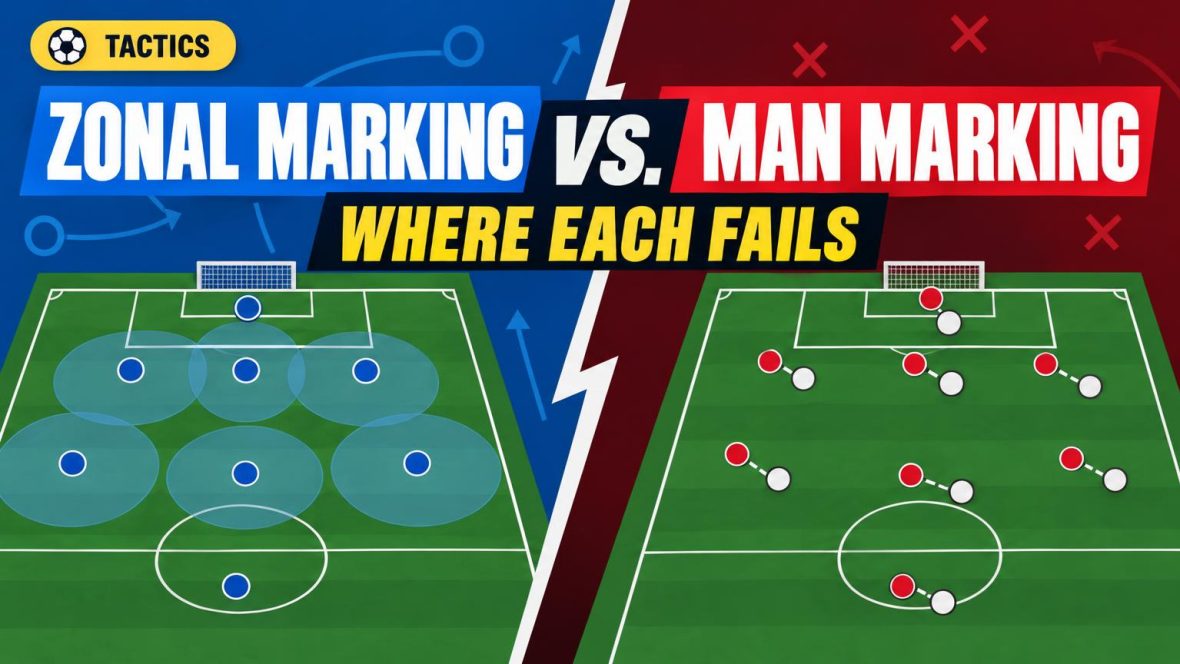
A zonal defender protects an area; a man-marking defender tracks an opponent. Most teams mix the two, so the distinction is best tested as a specific responsibility within a broader tactical system, rather than as a label for the entire back line. In TacticalPad, keep the defensive shape, attacking run, and delivery identical across each version.
Set the same wide free kick
Place four defenders across the box and send one attacker from the penalty spot toward the near-post channel. Draw the same inswinging delivery there each time; changing the ball’s path would make the comparison less useful.
Test the two responsibilities
Under zonal instructions, the near-post defender holds the channel and attacks the ball, while the central defender must decide when to pass the runner on. Under man marking, the assigned defender follows the runner; check whether that movement opens space behind.
Look for the conflict
A hybrid assignment might keep one defender in the channel while another tracks the runner. Pause the animation as the runner crosses between them: who takes the player, who protects the space, and can both duties be met before the ball arrives?
TacticalPad makes the competing assignments visible; it cannot establish how quickly defenders would recognize the handoff in a match.
Following the runner
Where the zonal handoff breaks
In TacticalPad, a diagonal run makes the handoff problem easy to see. A midfielder starts outside the full-back, then cuts into the centre-back’s zone as the ball moves wide. Pause when the runner crosses between them: the full-back is losing the angle to follow, while the centre-back is watching the ball. One step later, the runner reaches the centre-back’s blind side, ready for a cutback.
That picture reveals a decision point, but not the reason for the failure. Two versions of the same movement help separate them:
Unclear rule: The full-back releases the runner, but nobody has been assigned to pick up the run. Both defenders can follow their instructions and still leave a gap.
Poor execution: The centre-back is responsible for taking over but checks too late, misses a teammate’s call, or turns after the pass is played.
Keep the ball path and attacking run unchanged when comparing those versions. For marking responsibilities in a low block, the useful question is not simply which defender ended up nearest the runner. It is when the switch should be called and who must respond. TacticalPad can mark that moment clearly; the timing, communication, and shoulder check still have to be tested on the pitch.
When a marker follows the decoy
A decoy run can make man marking look perfectly organized right up to the moment it fails. Start with a striker pulling toward the touchline and a centre-back following. The assignment is clear, but the centre-back’s departure opens a channel for a midfielder arriving from deep.
In TacticalPad, keeping the ball movement unchanged while drawing both runs makes the problem easier to see. If the centre-back stays tight to the striker, who covers the space behind him? If he releases the striker, does a teammate take over before the pass goes wide? The arrows show the intended movements; they cannot prove that either defender would recognize the cue in time.
The awkward moment is often lost contact rather than a clean decision to switch. The centre-back turns toward the ball, the striker changes pace, and the covering defender steps across a beat late. For an instant, one attacker is untracked and the channel remains open. Labeling the switch on a diagram does not remove that gap.
Defensive height changes the cost of the mistake. In a mid block versus low block, the same centre-back may have very different amounts of space behind him. A higher line leaves more room for the arriving runner; a deeper line may give the covering defender less time to react near goal. The useful test is not just who marks whom, but who protects the vacated lane while assignments change.
Practical test
Run the same move under three marking rules
01
Build one starting picture
Place both teams on a free-kick diagram in TacticalPad: defenders across the six-yard area, attackers at the edge of the box, and the ball in a fixed position. Keep the delivery and every starting position unchanged across the three versions.
02
Draw the attacker’s run
Move one attacker from the near-post lane across the central defender’s area. Add the same run arrow to each version, leaving the other attackers in place so any new gap comes from the marking rule, not a different play.
03
Test zonal responsibility
Mark the space each defender protects. At the point where the attacker crosses between areas, draw who takes over and check whether the near-post lane or central lane is left without cover.
04
Test man marking
Assign a defender to follow that attacker across the shape. Trace the defender’s path and look for the space left behind, especially if another attacker could run into it.
05
Test a hybrid
Keep a near-post defender in place while a designated marker follows the runner. Compare the three diagrams at the same point in the run: the useful question is not which has no gap, but who must notice and cover it.
A clean diagram is not a completed handoff
TacticalPad makes assignments and exposed lanes easier to see. A drawing cannot establish whether a defender recognizes the run, communicates the switch, or arrives before the ball.
+ Shows the space left when a marker follows a runner
+ Allows the same play to be compared under different marking rules
Cons
− Cannot show whether defenders will communicate in time
− Does not establish how ball pressure changes the play
Best for
Coaching discussionsSet-piece planning
Not for
Proving match readiness
7.0
Assignment clarity
8.0
Exposed-space visibility
7.5
Scenario comparison
7.0
Match execution evidence
3.0
TacticalPad earns its place in the conversation when defenders disagree about who takes a runner or which space needs cover. Its animated drills and 3D views can make those competing assignments easier to inspect. The category scores are editorial judgments about that explanatory value, not measurements of defensive performance. Whether a handoff succeeds depends on timing, communication, ball pressure, and player judgment; footage and practice are better tests of those questions.
Neither system wins by default. In TacticalPad, keep the same free-kick run and draw three versions. Under zonal marking, one defender holds the near-post lane while the next takes the runner on entry. Under man marking, the marker follows the runner while an adjacent defender protects the space left behind. In a hybrid, the marker tracks until the runner crosses an agreed handoff line, where cover takes over. Write both defenders’ jobs beside each diagram, then check footage for when they actually react—or rehearse the sequence on the pitch. A tidy arrow cannot show whether the call arrives in time.
Top Free Bets for November
BetUS
200% up to $1,000
18+. Full T&C's apply. Sports bonus: 100% match up to $500. Casino bonus: 100% match up to $500. Enter promo code NEW200 at deposit and get up to a $1000 bonus. Valid on your first three (3) deposits. Available for all deposit methods. Minimum deposit of $50.
18+. Full terms apply. The Bet Back Bonus is available for new customers on first-time deposits of $50 or more. To redeem, select the offer in the cashier while completing your first deposit. Make your pick(s) in the Sportsbook and then select ‘Opt In to Use Your Bonus’. A Bet Back Bonus pop-up will display, select ‘Claim’ and then enter the risk amount to place your bet. If it wins, you keep your profits. If it loses, get 100% of your risk refunded as Free Play with only 1-time rollover. Free Play can then be used to place bets in the Sportsbook and earn cash. Additional T&Cs apply, please visit MyBookie to access the Help Center or contact Live Chat for more details.
18+. Full T&C's apply. This promotion is available only to new accounts in North America. Freeplay amount must be wagered five times (5x rollover) before it becomes eligible for withdrawal. Only prematch (sportsbook) bets count toward the 5x rollover requirement. Each person may claim only one bonus. If a customer creates multiple accounts to exploit this promotion, bet105 will mark all related accounts as ineligible and reclaim the funds. If a client receives more than two free bets without making a deposit, any winnings from those bets will be forfeited. This promotion applies only to the initial deposit or if specifically assigned by bet105.
18+. Full terms apply. New BUSR members only. Minimum deposit of $50 required per qualifying deposits. Codes 300SB1, 300SB2, and 300SB3 must be entered at the time of each corresponding deposit.
Each code is valid one time only. Each bonus code must be claimed at least 24 hours apart. Only one promo code may be applied per deposit. A 20x rollover requirement applies to the combined total of your initial deposit and bonus before any withdrawal can be made. Redeemable in the Sportsbook only. BUSR management reserves the right to modify, suspend, or cancel this promotion at any time. Redeem each promo code in the cashier to get your bonus. Must be 18 or older. Please gamble responsibly. General House Rules Apply.
18+. Full terms apply. 100% up to $500 Bonus. Valid for non-crypto payment methods only. Minimum deposit amount $50. This offer is not available to customers from Canada or Mexico. The bonus code must be redeemed immediately after the deposit and before a wager has been placed. The sum of the deposit and the bonus are subject to rollover requirements of 12x at min. odds of -200 (1.5) before a new code can be redeemed. Max. $500 of each bet count towards the rollover requirements. Only bets placed on options that take place count towards the rollover requirements. Wagers on Horse Racing and Boosted Odds do not count towards the rollover requirements. All general Everygame Sportsbook rules apply.
21+. Full T&C's apply. Bonus: 35% of qualifying deposit, up to $105. Rollover: 8× (only sports action counts towards the rollover) deposit + bonus. Expiry: 7 days after credit. Hold period: 2 weeks. Payouts allowed only after rollover and hold period are completed. Example: Deposit $200 → Receive $50 Sports Free Play. Sports Free Play Rules: see the BetAnything General Reward Rules for eligible sports, wager types, odds, and rollover rules.
18+. Full T&C's apply. This bonus can only be redeemed on your first deposit. Rollover is 5x Sports/5x Horses/30x Casino on both the initial deposit and the bonus amount. Rollover in our Sportsbook, for winning wagers, will be determined by the lesser of your risk or win amount at the time of wager settlement; for losing wagers your risk amount will be credited to your rollover contribution. Bonus funds cannot be used for play on Live Dealer games. Live Dealer play does not count toward meeting Casino rollover requirements for withdrawal. If a withdrawal is made before the bonus terms are met, all bonus funds as well as any money earned by wagering the bonus will be forfeited.
Hi I'm Andy and I love to report on the latest football scores and Tables. I also like to have a bet on the football and occasionaly on the horses. On this website I have new bookmaker offers listed that will give you free bets and bonuses to help you beat the bookies. Enjoy your stay.