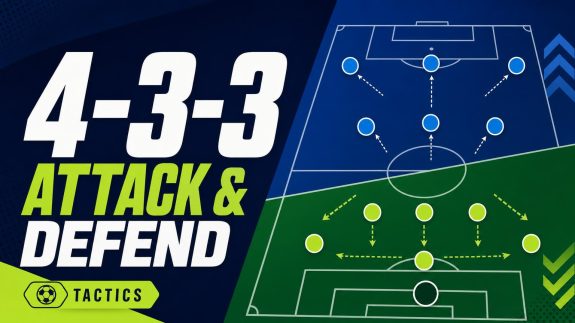
A winger follows an overlapping full-back into the defensive third, and a listed 4-3-3 suddenly looks like a 4-5-1. That does not mean the team has changed formation. The winger may simply be tracking a run; once the ball moves away, the forward line may reform.
Top Free Bets for October
BetUS
200% up to $1,000
18+. Full T&C's apply. Sports bonus: 100% match up to $500. Casino bonus: 100% match up to $500. Enter promo code NEW200 at deposit and get up to a $1000 bonus. Valid on your first three (3) deposits. Available for all deposit methods. Minimum deposit of $50.
18+. Full terms apply. The Bet Back Bonus is available for new customers on first-time deposits of $50 or more. To redeem, select the offer in the cashier while completing your first deposit. Make your pick(s) in the Sportsbook and then select ‘Opt In to Use Your Bonus’. A Bet Back Bonus pop-up will display, select ‘Claim’ and then enter the risk amount to place your bet. If it wins, you keep your profits. If it loses, get 100% of your risk refunded as Free Play with only 1-time rollover. Free Play can then be used to place bets in the Sportsbook and earn cash. Additional T&Cs apply, please visit MyBookie to access the Help Center or contact Live Chat for more details.
18+. Full T&C's apply. This promotion is available only to new accounts in North America. Freeplay amount must be wagered five times (5x rollover) before it becomes eligible for withdrawal. Only prematch (sportsbook) bets count toward the 5x rollover requirement. Each person may claim only one bonus. If a customer creates multiple accounts to exploit this promotion, bet105 will mark all related accounts as ineligible and reclaim the funds. If a client receives more than two free bets without making a deposit, any winnings from those bets will be forfeited. This promotion applies only to the initial deposit or if specifically assigned by bet105.
18+. Full terms apply. New BUSR members only. Minimum deposit of $50 required per qualifying deposits. Codes 300SB1, 300SB2, and 300SB3 must be entered at the time of each corresponding deposit.
Each code is valid one time only. Each bonus code must be claimed at least 24 hours apart. Only one promo code may be applied per deposit. A 20x rollover requirement applies to the combined total of your initial deposit and bonus before any withdrawal can be made. Redeemable in the Sportsbook only. BUSR management reserves the right to modify, suspend, or cancel this promotion at any time. Redeem each promo code in the cashier to get your bonus. Must be 18 or older. Please gamble responsibly. General House Rules Apply.
18+. Full terms apply. 100% up to $500 Bonus. Valid for non-crypto payment methods only. Minimum deposit amount $50. This offer is not available to customers from Canada or Mexico. The bonus code must be redeemed immediately after the deposit and before a wager has been placed. The sum of the deposit and the bonus are subject to rollover requirements of 12x at min. odds of -200 (1.5) before a new code can be redeemed. Max. $500 of each bet count towards the rollover requirements. Only bets placed on options that take place count towards the rollover requirements. Wagers on Horse Racing and Boosted Odds do not count towards the rollover requirements. All general Everygame Sportsbook rules apply.
21+. Full T&C's apply. Bonus: 35% of qualifying deposit, up to $105. Rollover: 8× (only sports action counts towards the rollover) deposit + bonus. Expiry: 7 days after credit. Hold period: 2 weeks. Payouts allowed only after rollover and hold period are completed. Example: Deposit $200 → Receive $50 Sports Free Play. Sports Free Play Rules: see the BetAnything General Reward Rules for eligible sports, wager types, odds, and rollover rules.
18+. Full T&C's apply. This bonus can only be redeemed on your first deposit. Rollover is 5x Sports/5x Horses/30x Casino on both the initial deposit and the bonus amount. Rollover in our Sportsbook, for winning wagers, will be determined by the lesser of your risk or win amount at the time of wager settlement; for losing wagers your risk amount will be credited to your rollover contribution. Bonus funds cannot be used for play on Live Dealer games. Live Dealer play does not count toward meeting Casino rollover requirements for withdrawal. If a withdrawal is made before the bonus terms are met, all bonus funds as well as any money earned by wagering the bonus will be forfeited.
Watch several spells when the team is settled, rather than counting players during a counterattack or a scramble near goal. Notice where the back line stands and whether the midfield repeatedly has one deeper player behind two others, or two players side by side. Then check again when possession changes. A lineup graphic gives a useful starting guess, but the arrangement players return to most often is better evidence of their usual shape.
Wait for play to settle
The opening whistle is a poor freeze-frame. A striker may stand beside a winger for kickoff, and the first loose ball can pull half the team toward one touchline. Let play run for a few minutes before naming a formation.
Look for a wide-camera passage in which the ball stays in play long enough for both teams to spread out. A slow buildup from the goalkeeper, followed by possession across midfield, can show where players position themselves when nobody is scrambling. If the broadcast cuts close, wait for another long view rather than guessing where the missing players went.
Watch the same team through two or three settled sequences. In possession, note who holds the width, who drops toward the centre-backs, and how many stay high. When the team defends without an immediate counterattack, check whether those players return to similar lines. A full-back overlapping once is a run; repeatedly starting high and wide suggests a pattern.
The lineup graphic helps identify players and their expected roles, but it is not a map of their positions after kickoff. It may show a 4-3-3 while a midfielder repeatedly steps alongside the defenders during buildup. Give the recurring picture on the pitch more weight, and keep the label provisional until another passage supports it.
Count the players across the back
Start with the deepest outfield line; leave the goalkeeper out of the count. During settled buildup, look for the players who repeatedly stay behind the ball. Four defenders spread across the pitch suggest a back four. Three central defenders holding their positions while two wide teammates move further up the touchlines suggest a back three with wing-backs.
The wide players provide the best check. In a back four, the full-backs usually return to either side of the centre-backs when the team settles into defence, with wide attackers ahead of them. In a back three, the wing-backs may start higher in possession, then drop alongside the three central defenders to make a line of five when defending deep.
Watch more than one passage of play before settling on a count. A full-back can overlap into attack while the other defenders shift across, briefly making a back four look like a three. A winger can also track back and make a back four look like five. The useful clue is where those wide players return regularly, not where they appear during one run.
Check the far side
When play is on one flank, glance at the wide player on the opposite side. Their position is often easier to judge away from the ball.
Map the midfield from back to front
Once the back line is clear, watch the space directly in front of it. The midfielder who regularly occupies that space is the pivot: a player who offers a passing option in buildup and helps shield the defenders when possession is lost. Some teams use one pivot; others use two side by side.
To tell a midfield three from two deeper players behind an attacking midfielder, follow the same players through several settled passages. In a midfield three, one player may sit behind two teammates, or all three may shift across at similar depths. With a deeper pair, two players repeatedly stay closer to the defenders while a third operates nearer the striker, often between the opposition’s midfield and back lines. That recurring gap is more revealing than a single forward run.
A wide view helps when the ball moves from one flank to the other: do the two deeper players remain available behind the attack, or does one consistently join the player ahead? An attacking midfielder might drop beside the pair to receive a pass, just as a central midfielder might surge beyond the forwards. Neither touch alone changes the likely shape. The distinctions in football formation fundamentals become easier to apply when based on where players return after those movements, especially as the team resets to defend.
Count the forwards and name the shape
Once the back line and midfield are mapped, look for the players who regularly stay highest during settled attacks. One central striker usually gives the formation a “1” at the end; two forwards who repeatedly occupy central lanes may give it a “2.” A winger joining the striker for one cross does not necessarily count as a second striker.
Next, watch where the wide attackers start when possession is secure, before a run or switch pulls them elsewhere. In a 4-3-3, two usually start either side of the central forward, making a front line of three. In a 4-2-3-1, the wide attackers commonly start alongside an attacking midfielder, behind the striker. Both sets of wide players may end up in the box, so their positions in one attack can be misleading.
Put the counts together from back to front: four defenders, two deeper midfielders, three advanced midfielders and one striker suggest 4-2-3-1. Four defenders, three midfielders and three forwards suggest 4-3-3. These shapes can look much the same from a distance; the useful check is whether one central midfielder regularly plays ahead of a deeper pair, or three players form the central midfield line. Keep the label provisional and check it against several settled spells, particularly after substitutions or a change in approach.
Compare shapes in and out of possession
A formation label is more useful when it names the phase of play. Once a team has settled on the ball, note where its wide players and midfielders usually stand. Then watch a spell of settled defending and count the lines again. The two views may produce different, equally accurate descriptions.
A team that builds in a 4-3-3 may defend in a 4-5-1. Its two wide forwards drop alongside the three central midfielders, leaving one striker ahead of them. Those forwards have not necessarily become permanent midfielders; the 4-5-1 describes where they defend, while the 4-3-3 describes their positions in possession.
The same shift can change the apparent back line. A team with three centre-backs in possession may look like a back five when its wing-backs retreat beside them. Check whether those wide players regularly move forward as outlets when the team regains the ball. If they do, calling the side a back three in possession and a back five out of possession is clearer than choosing one label for the entire match.
Compare several settled sequences before settling on either label. An attacker chasing a pass or a wing-back temporarily caught deep can make one frame misleading; repeated starting positions show the pattern.
Recheck the shape after a change
A formation label need not hold for the whole match. After a substitution, a goal, or a clear shift in pressing or defending, watch the next few settled passages. A replacement may take the same position as the player who left; a team protecting a lead may defend deeper without changing its lines.
Look for an arrangement that repeats when players have time to organize:
Does the substituted player consistently occupy a different line or lane?
Do the back-line and midfield counts change, or is one player just covering a teammate?
Does the new spacing return after restarts and changes of possession?
A winger dropping beside a full-back to stop one attack does not make a back five. If that winger repeatedly starts deep in settled defending, the defensive shape may have changed even if the attacking shape has not. Likewise, a striker chasing the goalkeeper once is not evidence of a new pressing shape.
Record a new label and an approximate minute only after several settled passages support it: “around 65′, 4-4-2 without the ball.” If the camera stays tight or play remains frantic, leave the earlier label provisional rather than assigning an exact moment to an uncertain switch.
Step List
Write down the line counts
Record the repeated back-line, midfield and forward counts, with a provisional formation label.
Note both phases
If the team defends in a different shape, record that separately from its shape in possession.
Mark any later switch
Add an approximate match minute only when the new spacing lasts beyond a single passage.
Test a quick pitch sketch
Draw the positions, label the shape and minute, then compare the sketch with the next settled passage. Revise the label if the players repeatedly line up elsewhere.
Conclusion
A useful record says what the team repeatedly looked like, in which phase, and roughly when it changed. A defensible description beats an exact-looking label drawn from one fleeting moment.
Top Free Bets for October
BetUS
200% up to $1,000
18+. Full T&C's apply. Sports bonus: 100% match up to $500. Casino bonus: 100% match up to $500. Enter promo code NEW200 at deposit and get up to a $1000 bonus. Valid on your first three (3) deposits. Available for all deposit methods. Minimum deposit of $50.
18+. Full terms apply. The Bet Back Bonus is available for new customers on first-time deposits of $50 or more. To redeem, select the offer in the cashier while completing your first deposit. Make your pick(s) in the Sportsbook and then select ‘Opt In to Use Your Bonus’. A Bet Back Bonus pop-up will display, select ‘Claim’ and then enter the risk amount to place your bet. If it wins, you keep your profits. If it loses, get 100% of your risk refunded as Free Play with only 1-time rollover. Free Play can then be used to place bets in the Sportsbook and earn cash. Additional T&Cs apply, please visit MyBookie to access the Help Center or contact Live Chat for more details.
18+. Full T&C's apply. This promotion is available only to new accounts in North America. Freeplay amount must be wagered five times (5x rollover) before it becomes eligible for withdrawal. Only prematch (sportsbook) bets count toward the 5x rollover requirement. Each person may claim only one bonus. If a customer creates multiple accounts to exploit this promotion, bet105 will mark all related accounts as ineligible and reclaim the funds. If a client receives more than two free bets without making a deposit, any winnings from those bets will be forfeited. This promotion applies only to the initial deposit or if specifically assigned by bet105.
18+. Full terms apply. New BUSR members only. Minimum deposit of $50 required per qualifying deposits. Codes 300SB1, 300SB2, and 300SB3 must be entered at the time of each corresponding deposit.
Each code is valid one time only. Each bonus code must be claimed at least 24 hours apart. Only one promo code may be applied per deposit. A 20x rollover requirement applies to the combined total of your initial deposit and bonus before any withdrawal can be made. Redeemable in the Sportsbook only. BUSR management reserves the right to modify, suspend, or cancel this promotion at any time. Redeem each promo code in the cashier to get your bonus. Must be 18 or older. Please gamble responsibly. General House Rules Apply.
18+. Full terms apply. 100% up to $500 Bonus. Valid for non-crypto payment methods only. Minimum deposit amount $50. This offer is not available to customers from Canada or Mexico. The bonus code must be redeemed immediately after the deposit and before a wager has been placed. The sum of the deposit and the bonus are subject to rollover requirements of 12x at min. odds of -200 (1.5) before a new code can be redeemed. Max. $500 of each bet count towards the rollover requirements. Only bets placed on options that take place count towards the rollover requirements. Wagers on Horse Racing and Boosted Odds do not count towards the rollover requirements. All general Everygame Sportsbook rules apply.
21+. Full T&C's apply. Bonus: 35% of qualifying deposit, up to $105. Rollover: 8× (only sports action counts towards the rollover) deposit + bonus. Expiry: 7 days after credit. Hold period: 2 weeks. Payouts allowed only after rollover and hold period are completed. Example: Deposit $200 → Receive $50 Sports Free Play. Sports Free Play Rules: see the BetAnything General Reward Rules for eligible sports, wager types, odds, and rollover rules.
18+. Full T&C's apply. This bonus can only be redeemed on your first deposit. Rollover is 5x Sports/5x Horses/30x Casino on both the initial deposit and the bonus amount. Rollover in our Sportsbook, for winning wagers, will be determined by the lesser of your risk or win amount at the time of wager settlement; for losing wagers your risk amount will be credited to your rollover contribution. Bonus funds cannot be used for play on Live Dealer games. Live Dealer play does not count toward meeting Casino rollover requirements for withdrawal. If a withdrawal is made before the bonus terms are met, all bonus funds as well as any money earned by wagering the bonus will be forfeited.
Hi I'm Andy and I love to report on the latest football scores and Tables. I also like to have a bet on the football and occasionaly on the horses. On this website I have new bookmaker offers listed that will give you free bets and bonuses to help you beat the bookies. Enjoy your stay.