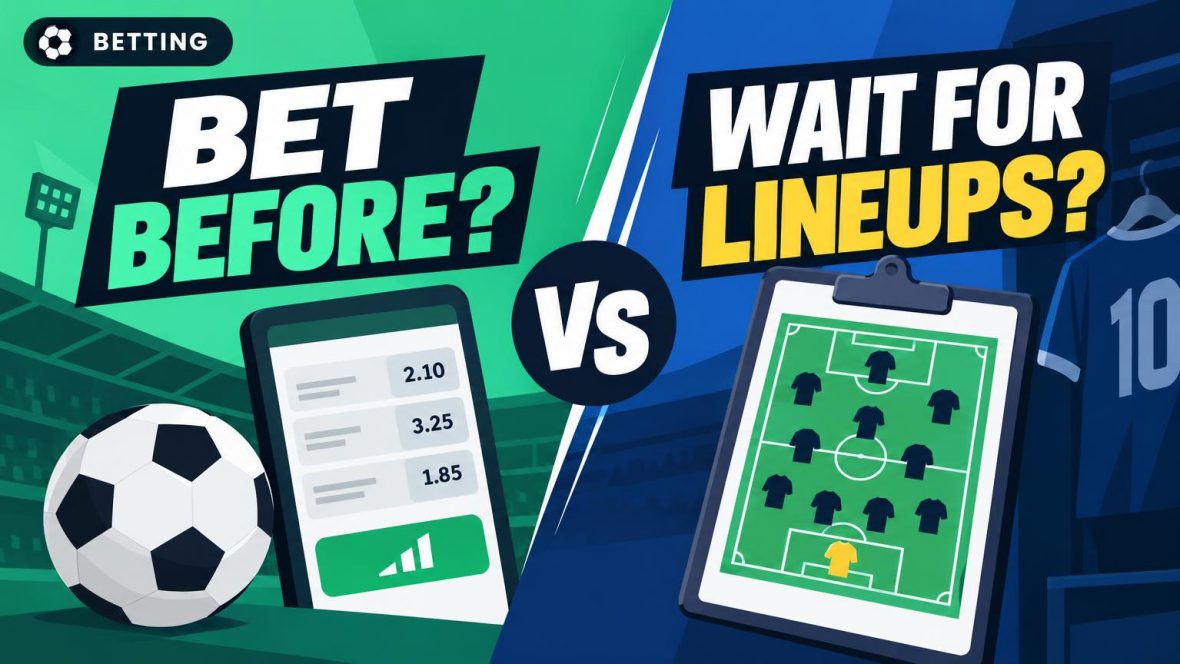
A tempting price can carry a hidden question mark.
A team is priced at 2.20 on Thursday, but its leading scorer is still doubtful for Saturday. The odds may look generous because the market has already allowed for that uncertainty. Backing the team now locks in the price and the risk that the scorer misses out.
Top Free Bets for November
BetUS
200% up to $1,000
18+. Full T&C's apply. Sports bonus: 100% match up to $500. Casino bonus: 100% match up to $500. Enter promo code NEW200 at deposit and get up to a $1000 bonus. Valid on your first three (3) deposits. Available for all deposit methods. Minimum deposit of $50.
18+. Full terms apply. The Bet Back Bonus is available for new customers on first-time deposits of $50 or more. To redeem, select the offer in the cashier while completing your first deposit. Make your pick(s) in the Sportsbook and then select ‘Opt In to Use Your Bonus’. A Bet Back Bonus pop-up will display, select ‘Claim’ and then enter the risk amount to place your bet. If it wins, you keep your profits. If it loses, get 100% of your risk refunded as Free Play with only 1-time rollover. Free Play can then be used to place bets in the Sportsbook and earn cash. Additional T&Cs apply, please visit MyBookie to access the Help Center or contact Live Chat for more details.
18+. Full T&C's apply. This promotion is available only to new accounts in North America. Freeplay amount must be wagered five times (5x rollover) before it becomes eligible for withdrawal. Only prematch (sportsbook) bets count toward the 5x rollover requirement. Each person may claim only one bonus. If a customer creates multiple accounts to exploit this promotion, bet105 will mark all related accounts as ineligible and reclaim the funds. If a client receives more than two free bets without making a deposit, any winnings from those bets will be forfeited. This promotion applies only to the initial deposit or if specifically assigned by bet105.
18+. Full terms apply. New BUSR members only. Minimum deposit of $50 required per qualifying deposits. Codes 300SB1, 300SB2, and 300SB3 must be entered at the time of each corresponding deposit.
Each code is valid one time only. Each bonus code must be claimed at least 24 hours apart. Only one promo code may be applied per deposit. A 20x rollover requirement applies to the combined total of your initial deposit and bonus before any withdrawal can be made. Redeemable in the Sportsbook only. BUSR management reserves the right to modify, suspend, or cancel this promotion at any time. Redeem each promo code in the cashier to get your bonus. Must be 18 or older. Please gamble responsibly. General House Rules Apply.
18+. Full terms apply. 100% up to $500 Bonus. Valid for non-crypto payment methods only. Minimum deposit amount $50. This offer is not available to customers from Canada or Mexico. The bonus code must be redeemed immediately after the deposit and before a wager has been placed. The sum of the deposit and the bonus are subject to rollover requirements of 12x at min. odds of -200 (1.5) before a new code can be redeemed. Max. $500 of each bet count towards the rollover requirements. Only bets placed on options that take place count towards the rollover requirements. Wagers on Horse Racing and Boosted Odds do not count towards the rollover requirements. All general Everygame Sportsbook rules apply.
21+. Full T&C's apply. Bonus: 35% of qualifying deposit, up to $105. Rollover: 8× (only sports action counts towards the rollover) deposit + bonus. Expiry: 7 days after credit. Hold period: 2 weeks. Payouts allowed only after rollover and hold period are completed. Example: Deposit $200 → Receive $50 Sports Free Play. Sports Free Play Rules: see the BetAnything General Reward Rules for eligible sports, wager types, odds, and rollover rules.
18+. Full T&C's apply. This bonus can only be redeemed on your first deposit. Rollover is 5x Sports/5x Horses/30x Casino on both the initial deposit and the bonus amount. Rollover in our Sportsbook, for winning wagers, will be determined by the lesser of your risk or win amount at the time of wager settlement; for losing wagers your risk amount will be credited to your rollover contribution. Bonus funds cannot be used for play on Live Dealer games. Live Dealer play does not count toward meeting Casino rollover requirements for withdrawal. If a withdrawal is made before the bonus terms are met, all bonus funds as well as any money earned by wagering the bonus will be forfeited.
Waiting for the starting lineup removes that particular guess. If the scorer starts, though, the price may have shortened; if the scorer is absent, a longer price may still be poor value. The choice depends on how much the player’s availability changes the bet, not simply on whether the current number looks attractive.
How team news moves the price
An injury report rarely moves a price in a predictable way. A manager calling a starter “a doubt” may shorten the opponent’s odds, but a report the market already expected may do little. Training photos, travel squads and local reporting offer clues; none guarantees a place in the starting eleven.
Odds also respond to bets, not just announcements. If many bettors back one side after a credible selection hint, bookmakers may shorten that price before the team sheet appears. The way odds change after lineups depends partly on how much of the news the earlier price already reflected.
Starting elevens commonly appear about an hour before kick-off, though timing varies by competition. Waiting removes much of the guesswork over starters, but it can mean accepting shorter odds or finding a market briefly suspended. A named starter can still withdraw during the warm-up, and a confirmed eleven reveals little about a player’s fitness or likely minutes.
Before committing
Does the missing player change this bet?
01
The market’s exposure
A missing striker matters directly to an anytime-scorer bet; a missing defender may matter more to a clean-sheet bet. Judge the absence against the actual selection, not the player’s reputation.
Worth checking
A clear link between the player’s role and the bet
Reason to pause
Treating every absence as equally important
02
The replacement
A capable backup in the same role may soften the loss. An unfamiliar replacement, or a reshuffle that weakens two positions, makes an early bet harder to defend.
Worth checking
A credible like-for-like option
Reason to pause
Assuming any substitute preserves the same approach
03
The strength of the report
A coach’s specific fitness concern carries more weight than an unverified social post. Recent minutes and fixture congestion add context to reports about doubtful players, but neither confirms an absence.
Worth checking
A sourced concern supported by the schedule
Reason to pause
Turning rotation guesses into lineup facts
04
The lineup that breaks the bet
Name the starting XI that would make the price unattractive. If the selection depends on one player starting, waiting for lineups may be worth more than securing the early price.
Worth checking
A specific lineup-based stopping point
Reason to pause
Betting early without knowing what would change the decision
Set a lineup limit
For a team-goals bet, the main striker starting may not be enough if both regular chance-creators are benched. That is a clearer reason to pass than a vague fear of rotation.
Put a number on the uncertainty
Suppose a team is 2.20 to win before lineups are announced. In decimal odds, 1 ÷ 2.20 gives a 45.5% break-even probability: the bet needs to win more often than that to be worthwhile over time. The price alone does not say how likely the team really is to win.
A cautious estimate might put its win chance at 52% with the expected starters and 40% if a key player is absent. If the expected starters seem 60% likely to play, the combined estimate is 0.60 × 52% + 0.40 × 40% = 47.2%. That leaves only a small gap above the break-even point, so a modest error in either estimate could erase it. Still, the early 2.20 can compensate for some bad-news risk; waiting for certainty may mean accepting shorter odds.
Bookmaker margin matters, too. If the opposing outcome is priced at 1.75, its implied probability is 57.1%. Added to 45.5%, that is 102.6%, not 100%. Those quoted probabilities include the bookmaker’s margin; they are not a clean forecast of the match.
If 2.20 later falls to 2.00, that move does not prove the early bet was sound. Bets placed by others, a bookmaker’s adjustment or genuinely encouraging team news could all contribute. The useful comparison is the price available at the time against a defensible estimate that includes the lineup risk.
Which team news deserves trust?
Confirmed team sheets settle who starts, making them the strongest source for a lineup-dependent bet. Official club or competition updates come next: they can confirm an absence or a return to training, but a player declared available may still be short of a full match. Credible reporters can provide useful early clues; predicted XIs and unsourced rumours are much weaker evidence.
The type of uncertainty matters. A known absence can be assessed against the likely replacement. An uncertain return leaves both selection and minutes open. A rotation concern may involve a fully fit player whose place is at risk because of fixture congestion. The impact of football team absences depends on which of those questions the bet actually needs answered.
Check when each update was posted and whether it refers to this match. A morning prediction should not outweigh an afternoon club update. Even several reassuring reports cannot make a bet robust if its value depends on one unconfirmed player starting and playing most of the game.
Let the weakest assumption set the limit
If the price only looks attractive when an uncertain starter plays 90 minutes, wait for stronger evidence or pass.
When is betting early worth it?
An early bet is easier to justify when the price still looks worthwhile under every plausible lineup, not only the most optimistic one. At odds of 2.20, the break-even probability is about 45.5%. If a reasonable estimate for the weaker lineup is 48%, the bet has some room for error; if it is 46%, that apparent edge may be too thin to trust.
The uncertainty also needs to be contained. One doubtful starter matters less when a capable replacement is available than when that player is central to the bet. The stake should feel acceptable even if the less favourable team starts. If that outcome would make the bet regrettable, waiting for lineups is the cleaner choice.
An early price is not guaranteed to stay available, even when no decisive team news appears. Other bettors may reach a different view or move the market for unrelated reasons. Apps for faster football injury alerts can help track updates, but getting a notification first does not make a weak price valuable.
When waiting is the better bet
Some bets are hard to judge until the team sheet arrives. A player shots bet depends on a start and likely minutes; a team corners bet may hinge on whether the usual wide players are deployed. Taking an early price in those markets means pricing several unknowns at once.
Waiting makes particular sense when injury reports are vague or two credible lineups suggest very different games. A striker’s absence might bring in a similar replacement—or prompt an extra defensive midfielder and fewer attacking chances. Even if the expected names start, an unexpected shape can change their roles; formation effects on betting extend beyond the players listed on the sheet.
The confirmed price may be shorter, but it removes some guesswork. Compare the new odds with an estimate based on the actual lineup, including likely minutes and roles. If the remaining edge is too small to withstand ordinary estimation error, pass rather than chase a price that no longer exists.
An early bet, tested against two lineups
Suppose, in a hypothetical football match, the home side is 2.20 to win while its leading striker is doubtful. That price requires a win probability of about 45.5% to break even. A bettor estimates a 60% chance the striker starts, with the home side winning about 51% of the time if he does and 42% if he misses out. The weighted estimate is roughly 47%, leaving a small early edge—but not much room for a mistaken assumption.
Betting early could make sense for someone comfortable with those estimates and the possibility of holding a poor price if the striker is absent. A modest stake would reflect the narrow edge. The attraction is not that the striker is certain to play; it is that 2.20 may already pay enough for the risk that he does not.
If he starts, the home price might shorten to around 2.05, which requires about 49%. Against the 51% estimate, there could still be a bet after confirmation. Waiting makes sense if that smaller, clearer opportunity is preferable to carrying lineup uncertainty. But if the price falls to 1.95, the estimated edge disappears, even though the good news has arrived.
If the striker is left out, the price might drift to 2.35. That requires about 43%, slightly above the estimated 42% win chance: decline the bet. The higher odds are not automatically better odds. These prices are illustrations, not predictions; the useful comparison is always the available price against the estimate for the lineup actually named.
Odds and terms
Compare the bet, not just the price
01
The price available now
Compare the early odds with the odds actually offered after lineups, if the market remains open. A shorter price can erase the benefit of knowing who starts.
Check
An edge that survives the available price
Watch out for
Comparing confirmed news with an expired early price
02
Non-starter rules
For player bets, check whether a player must start, make an appearance or meet another condition for the bet to stand. An unused substitute may be treated differently from a late substitute.
Check
The rule for the exact player market
Watch out for
Assuming every non-starter is void
03
Settlement terms
Check what counts toward the result, including whether extra time is included. Player and match bets can also differ when a fixture is postponed or abandoned.
Check
Terms for the specific market and event
Watch out for
Applying one market’s rules to another
04
Access after lineups
A bookmaker may suspend a market as lineups arrive, then reopen it at new odds. Cash-out, where offered, may be unavailable during that period or priced unfavourably.
Check
A usable market at the time of the decision
Watch out for
Treating cash-out as a guaranteed exit
Rule check
A missing player does not void every bet
A player-specific bet might be void if the player does not appear, while a bet on the match result still stands. The outcome depends on the bookmaker’s rules for each market, not simply on the team news.
Step List
Name the lineup risk
Identify the player or rotation decision that could change the bet. A doubtful striker may matter greatly to a goals market but much less to a cards market.
Set a price for each outcome
Estimate the bet’s chance if the player starts, misses out or has a restricted role. Write down the lowest acceptable odds for each case, allowing room for error in those estimates.
Check the evidence and the bet
Confirm when the report was published and whether it comes from a reliable source. Read the bookmaker’s rules on non-starters and settlement; otherwise, the apparent price advantage may be for a different bet than expected.
Choose early, wait or pass
Bet early only if the current odds still look worthwhile across the plausible lineup outcomes. Wait if the lineup could change the decision, then compare the new odds with the relevant minimum. Pass if neither price clears it.
Keep the stake tolerable
Use an amount that remains comfortable if the lineup call is wrong. There is no need to increase the stake to make up for a smaller edge or a missed early price.
Conclusion
The useful decision is not whether the early price will shorten. It is whether the available price pays enough for the lineup uncertainty that remains. A missed bet costs nothing; a forced bet can lock in poor value.
Top Free Bets for November
BetUS
200% up to $1,000
18+. Full T&C's apply. Sports bonus: 100% match up to $500. Casino bonus: 100% match up to $500. Enter promo code NEW200 at deposit and get up to a $1000 bonus. Valid on your first three (3) deposits. Available for all deposit methods. Minimum deposit of $50.
18+. Full terms apply. The Bet Back Bonus is available for new customers on first-time deposits of $50 or more. To redeem, select the offer in the cashier while completing your first deposit. Make your pick(s) in the Sportsbook and then select ‘Opt In to Use Your Bonus’. A Bet Back Bonus pop-up will display, select ‘Claim’ and then enter the risk amount to place your bet. If it wins, you keep your profits. If it loses, get 100% of your risk refunded as Free Play with only 1-time rollover. Free Play can then be used to place bets in the Sportsbook and earn cash. Additional T&Cs apply, please visit MyBookie to access the Help Center or contact Live Chat for more details.
18+. Full T&C's apply. This promotion is available only to new accounts in North America. Freeplay amount must be wagered five times (5x rollover) before it becomes eligible for withdrawal. Only prematch (sportsbook) bets count toward the 5x rollover requirement. Each person may claim only one bonus. If a customer creates multiple accounts to exploit this promotion, bet105 will mark all related accounts as ineligible and reclaim the funds. If a client receives more than two free bets without making a deposit, any winnings from those bets will be forfeited. This promotion applies only to the initial deposit or if specifically assigned by bet105.
18+. Full terms apply. New BUSR members only. Minimum deposit of $50 required per qualifying deposits. Codes 300SB1, 300SB2, and 300SB3 must be entered at the time of each corresponding deposit.
Each code is valid one time only. Each bonus code must be claimed at least 24 hours apart. Only one promo code may be applied per deposit. A 20x rollover requirement applies to the combined total of your initial deposit and bonus before any withdrawal can be made. Redeemable in the Sportsbook only. BUSR management reserves the right to modify, suspend, or cancel this promotion at any time. Redeem each promo code in the cashier to get your bonus. Must be 18 or older. Please gamble responsibly. General House Rules Apply.
18+. Full terms apply. 100% up to $500 Bonus. Valid for non-crypto payment methods only. Minimum deposit amount $50. This offer is not available to customers from Canada or Mexico. The bonus code must be redeemed immediately after the deposit and before a wager has been placed. The sum of the deposit and the bonus are subject to rollover requirements of 12x at min. odds of -200 (1.5) before a new code can be redeemed. Max. $500 of each bet count towards the rollover requirements. Only bets placed on options that take place count towards the rollover requirements. Wagers on Horse Racing and Boosted Odds do not count towards the rollover requirements. All general Everygame Sportsbook rules apply.
21+. Full T&C's apply. Bonus: 35% of qualifying deposit, up to $105. Rollover: 8× (only sports action counts towards the rollover) deposit + bonus. Expiry: 7 days after credit. Hold period: 2 weeks. Payouts allowed only after rollover and hold period are completed. Example: Deposit $200 → Receive $50 Sports Free Play. Sports Free Play Rules: see the BetAnything General Reward Rules for eligible sports, wager types, odds, and rollover rules.
18+. Full T&C's apply. This bonus can only be redeemed on your first deposit. Rollover is 5x Sports/5x Horses/30x Casino on both the initial deposit and the bonus amount. Rollover in our Sportsbook, for winning wagers, will be determined by the lesser of your risk or win amount at the time of wager settlement; for losing wagers your risk amount will be credited to your rollover contribution. Bonus funds cannot be used for play on Live Dealer games. Live Dealer play does not count toward meeting Casino rollover requirements for withdrawal. If a withdrawal is made before the bonus terms are met, all bonus funds as well as any money earned by wagering the bonus will be forfeited.
Hi I'm Andy and I love to report on the latest football scores and Tables. I also like to have a bet on the football and occasionaly on the horses. On this website I have new bookmaker offers listed that will give you free bets and bonuses to help you beat the bookies. Enjoy your stay.