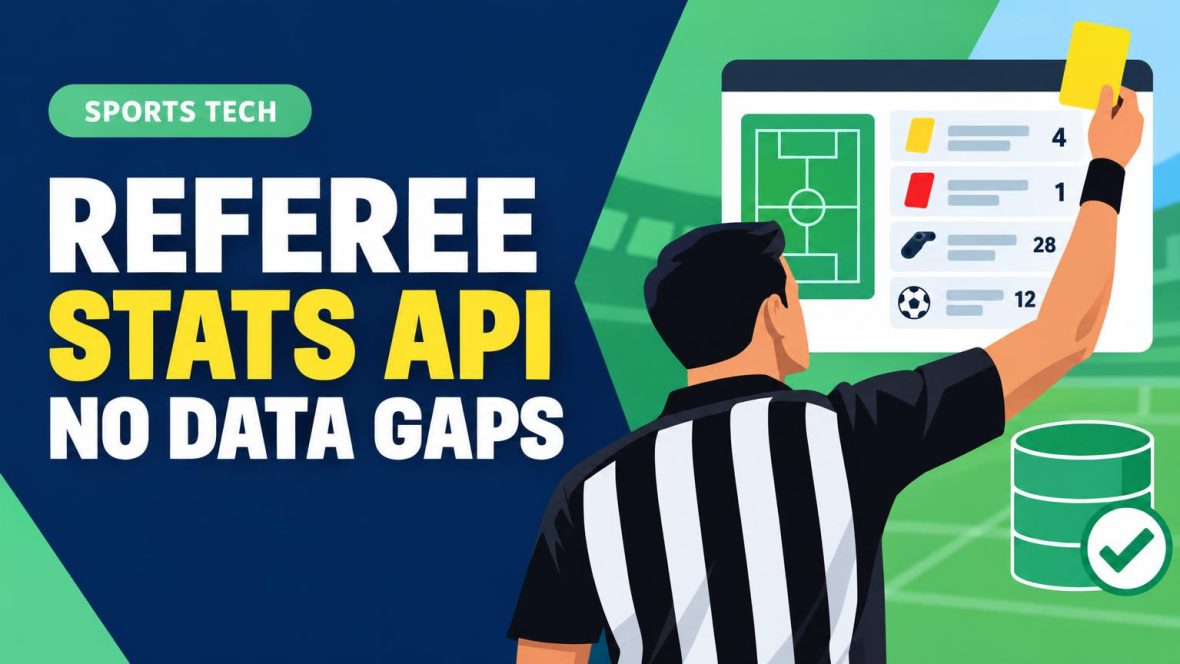
A card count is only as useful as the matches behind it.
A referee dashboard looks reliable until a lower-division match returns no card records. One API may include that fixture but omit bench bookings; another may not cover the competition at all. Both can advertise “card data,” yet those gaps mean different things. A missing record is especially risky when a dashboard or model treats it as zero cards.
Top Free Bets for November
BetUS
200% up to $1,000
18+. Full T&C's apply. Sports bonus: 100% match up to $500. Casino bonus: 100% match up to $500. Enter promo code NEW200 at deposit and get up to a $1000 bonus. Valid on your first three (3) deposits. Available for all deposit methods. Minimum deposit of $50.
18+. Full terms apply. The Bet Back Bonus is available for new customers on first-time deposits of $50 or more. To redeem, select the offer in the cashier while completing your first deposit. Make your pick(s) in the Sportsbook and then select ‘Opt In to Use Your Bonus’. A Bet Back Bonus pop-up will display, select ‘Claim’ and then enter the risk amount to place your bet. If it wins, you keep your profits. If it loses, get 100% of your risk refunded as Free Play with only 1-time rollover. Free Play can then be used to place bets in the Sportsbook and earn cash. Additional T&Cs apply, please visit MyBookie to access the Help Center or contact Live Chat for more details.
18+. Full T&C's apply. This promotion is available only to new accounts in North America. Freeplay amount must be wagered five times (5x rollover) before it becomes eligible for withdrawal. Only prematch (sportsbook) bets count toward the 5x rollover requirement. Each person may claim only one bonus. If a customer creates multiple accounts to exploit this promotion, bet105 will mark all related accounts as ineligible and reclaim the funds. If a client receives more than two free bets without making a deposit, any winnings from those bets will be forfeited. This promotion applies only to the initial deposit or if specifically assigned by bet105.
18+. Full terms apply. New BUSR members only. Minimum deposit of $50 required per qualifying deposits. Codes 300SB1, 300SB2, and 300SB3 must be entered at the time of each corresponding deposit.
Each code is valid one time only. Each bonus code must be claimed at least 24 hours apart. Only one promo code may be applied per deposit. A 20x rollover requirement applies to the combined total of your initial deposit and bonus before any withdrawal can be made. Redeemable in the Sportsbook only. BUSR management reserves the right to modify, suspend, or cancel this promotion at any time. Redeem each promo code in the cashier to get your bonus. Must be 18 or older. Please gamble responsibly. General House Rules Apply.
18+. Full terms apply. 100% up to $500 Bonus. Valid for non-crypto payment methods only. Minimum deposit amount $50. This offer is not available to customers from Canada or Mexico. The bonus code must be redeemed immediately after the deposit and before a wager has been placed. The sum of the deposit and the bonus are subject to rollover requirements of 12x at min. odds of -200 (1.5) before a new code can be redeemed. Max. $500 of each bet count towards the rollover requirements. Only bets placed on options that take place count towards the rollover requirements. Wagers on Horse Racing and Boosted Odds do not count towards the rollover requirements. All general Everygame Sportsbook rules apply.
21+. Full T&C's apply. Bonus: 35% of qualifying deposit, up to $105. Rollover: 8× (only sports action counts towards the rollover) deposit + bonus. Expiry: 7 days after credit. Hold period: 2 weeks. Payouts allowed only after rollover and hold period are completed. Example: Deposit $200 → Receive $50 Sports Free Play. Sports Free Play Rules: see the BetAnything General Reward Rules for eligible sports, wager types, odds, and rollover rules.
18+. Full T&C's apply. This bonus can only be redeemed on your first deposit. Rollover is 5x Sports/5x Horses/30x Casino on both the initial deposit and the bonus amount. Rollover in our Sportsbook, for winning wagers, will be determined by the lesser of your risk or win amount at the time of wager settlement; for losing wagers your risk amount will be credited to your rollover contribution. Bonus funds cannot be used for play on Live Dealer games. Live Dealer play does not count toward meeting Casino rollover requirements for withdrawal. If a withdrawal is made before the bonus terms are met, all bonus funds as well as any money earned by wagering the bonus will be forfeited.
Before committing to a feed, a buyer can check a small sample of known matches across the divisions and seasons that matter. Compare reported bookings with match reports, including cards shown to substitutes or staff. It is far cheaper to find an omission in a test than after a workflow depends on the numbers.
Coverage checklist
What the dataset must contain
01
Competitions and seasons
Name every required league and cup, with the exact seasons needed for analysis. Confirm that cup coverage includes the rounds that matter, not just the final.
Look for
A competition-by-season inventory with fixture counts
Watch out for
A broad claim that a league is covered
02
Match referee assignments
Each fixture needs a referee identifier tied to the match, including fixtures that moved dates. Check how the API handles assignments that change before kickoff.
Look for
A match ID, referee ID, date, and fixture status
Watch out for
A referee name available only in match text
03
Card events and referee totals
Specify the yellow and red card events needed, plus referee totals by competition and season. Check whether second-yellow dismissals have a distinct representation.
Look for
Event records and aggregates with clear counting rules
Watch out for
Totals that cannot be reconciled with match records
04
Supporting identifiers
Team IDs are useful for following promoted clubs across seasons; venue and player IDs depend on the intended analysis. Mark these as optional only if the work can proceed without them.
Look for
Stable IDs for the joins the analysis requires
Watch out for
Names used as the only join keys
Before buying
Prove coverage fixture by fixture
A league name on a coverage page is a starting point, not evidence of a complete season.
Put the minimum dataset in writing before comparing plans. For example: “All top-flight and domestic cup matches from 2021–22 through 2024–25, each with a match ID, referee assignment, card events, and referee season totals.” This makes it easier to spot a plan that supplies referee profiles but not the match records needed to check them. Decide at the same time whether team, venue, and player IDs are essential joins or useful extras.
Ask for a sample export or use a trial to count distinct match IDs by competition and season. Compare those counts with an independent fixture list, using the same definition of a season and counting completed, postponed, abandoned, and rescheduled fixtures separately. A postponed match should not silently disappear; its original and replacement records should either share an ID or have a documented relationship.
A small spot check can expose gaps that a headline count misses:
Check early and late cup rounds, including replays where the competition used them.
Follow a promoted team into its first season in the higher division; confirm that its fixtures and referee assignments appear throughout.
Open several matches from each sample group and verify that the referee ID and card events resolve to usable records.
Counts alone cannot prove every event is correct, but they reveal where to investigate. If the API reports 370 matches for a 380-match league season, request the missing match IDs rather than accepting an assurance that the league is “supported.” For help distinguishing a coverage gap from a genuine statistical pattern, start with referee data interpretation basics.
Card-count checks
Three card assumptions worth testing
Assumption
A second yellow is always counted as two yellow cards.
Check instead
Check whether the feed stores two cautions, a separate second-yellow event, or a combined dismissal event.
Why it matters
The same incident can produce different yellow-card totals under different aggregation rules.
Assumption
A red-card total equals the number of sendings-off.
Check instead
Check whether red-card totals include dismissals for second yellows or only straight reds.
Why it matters
A dismissal count may combine two routes to leaving the match.
Assumption
Every card belongs to a player on the pitch.
Check instead
Inspect recipient roles for substitutes and team staff.
Why it matters
Including bench cards in one referee’s totals but not another’s distorts comparisons.
Check the events behind the totals
Card rates are only comparable when the counting rules match.
A season summary can look complete while hiding how it was calculated. Before comparing referees’ cards per match, inspect a handful of fixture-level event records alongside the API’s reported totals. A useful sample includes a match with a second-yellow dismissal, one with a straight red, and one with a booking away from the field of play.
For each incident, record the event type, recipient, recipient role and referee ID. Then check whether the summary counts cautions issued, players cautioned, dismissal events, or some mixture. Two feeds can show the same match correctly yet report different yellow and red totals because they group those events differently. The question of whether a data feed includes bench cards is especially important when a rate combines on-field and off-field discipline.
A reliable referee ID matters just as much as a clear card definition. Match the ID on a referee profile to fixture records and, where available, individual card events. Repeat the check across a cup match and a league match, an older season, and any records where the displayed name changes format—for example, an initial replacing a first name. Names are labels, not dependable join keys.
If the same ID points to different people, or one referee receives unrelated IDs across competitions, ask the provider how identities are reconciled. Until that is clear, apparent changes in a referee’s card rate may be a join error rather than a change in officiating.
Test the feed on the clock
A complete match record may still arrive too late for the application that needs it.
Referee data has three different clocks. Pre-match assignments can change before kickoff; a feed that publishes the original appointment but not the replacement may be unsuitable for a match preview. Live events need both an event time and a publication or update time to show how far behind the match the feed runs. Post-match corrections matter when disciplinary reports amend a card or its recipient after the final whistle.
Check timing against the intended use, not a vendor’s general claim of “live” coverage. A next-day research database may tolerate corrections arriving hours later; a live card alert cannot. Ask whether timestamps include time zones, whether updated records retain the same event ID, and whether a correction can be retrieved without downloading the whole match again. The reasons referee datasets disagree are easier to investigate when the original and revised records can both be identified.
Retrieval behavior deserves the same scrutiny. Paginated match searches should have a stable sort order or cursor so records are not skipped while new results arrive. Check whether rate limits allow the planned polling schedule and a catch-up run after an outage. Finally, test what the API returns when an assignment is pending, a match is postponed, or a competition is not covered. A documented null, an empty event list, and a 404 response may mean different things; the application needs a reliable way to tell them apart.
Trial rule
Keep the raw responses
Save response bodies, status codes, request times, and pagination tokens. A later correction is difficult to verify if only the latest version of each match remains.
Run a fixture trial before signing
01
Fix the sample in advance
Select 12–20 dated fixtures across a prominent league, a lower-profile league, and any relevant cup rounds. Include an upcoming assignment, a postponed or rescheduled match, and recently completed games.
02
Capture the feed repeatedly
Query before kickoff, during play, shortly after full time, and again a day or two later. Record request and response times, available timestamps, IDs, HTTP status, null fields, and pagination results.
03
Compare an independent record
Use official league or federation match reports where available, rather than another site that may republish the same feed. Match fixtures by date, teams, and competition before comparing referees and card events.
04
Log every mismatch
Separate absent fixtures from absent fields, explicit nulls, delayed events, differing card definitions, and later corrections. Note whether retries or quota limits prevented a fair check.
Repeat the same queries for each candidate provider; a consistent fixture list makes differences easier to interpret.
Final checks
What makes a quote usable
01
A price for the tested scope
Ask for a quote covering the competitions, seasons, endpoints, backfill requests and live polling rate that passed the trial.
Look for
Costs and overage rules tied to a realistic request count
Avoid
A headline price that excludes history or live usage
02
Rights that match the product
Check whether the license permits storing historical data, displaying derived figures and redistributing records to customers.
Look for
Written terms for each intended use
Avoid
Assuming API access includes publication rights
03
Support when data changes
Ask how corrections, endpoint changes and competition coverage changes are announced, and what support is available when records disappear.
Look for
Clear notices and a route for reporting missing fixtures
Avoid
Silent schema changes with no practical support
04
A manageable gap workload
Estimate the time needed to detect missing records, resolve referee identities and repair historical figures.
Look for
Gaps small enough to track and correct
Avoid
A cheap feed that requires continual manual reconstruction
Buying decision
Choose the feed that remains usable
Compare the full cost of the tested coverage, not the entry-level plan.
Request pricing for only the endpoints and competitions that survived the fixture and live tests. A broad package is not a bargain if its referee field is absent in the league that matters. Build a request estimate from historical backfills, routine refreshes and matchday polling, then check it against rate limits and overage charges. For example, polling 20 fixtures once a minute for two hours produces 2,400 requests if each fixture needs its own call; a bulk endpoint changes that calculation substantially.
The quote should also cover the work outside the API bill. Historical corrections may require stored snapshots and recalculated averages; missing referee IDs may require a mapping table and review. If gaps are patched from another source, account for the time spent matching fixtures and checking whether its card definitions agree. An apparent saving can vanish after a season of manual repairs.
Publication rights deserve a separate check. Permission to retrieve data does not necessarily permit a public referee profile, a downloadable dataset or resale through another product. Confirm retention, attribution and redistribution terms in writing for the intended use. Ask how much notice accompanies breaking changes and coverage reductions, and whether support will investigate a specific missing fixture rather than send a generic coverage statement.
A broad sports API often suits a simpler site that needs referee names and basic card totals across many leagues, provided its tested coverage is sound. A specialist event feed is easier to justify when recipient roles, second yellows and event-level timing drive the analysis. Inexpensive, thin feeds can be useful for a prototype, but they are a risky foundation for multi-season models unless missing history can be measured and tolerated. The same trade-off applies to referee statistics platforms for bettors, where a tidy interface cannot compensate for absent fixtures. The best purchase is the feed whose verified coverage, permitted uses and upkeep fit the actual product.
Conclusion
A feed belongs on the shortlist only if it supplies the required data, passes the same fixture trial as its rivals, and remains affordable after usage and gap-repair costs. An isolated, clearly flagged historical omission may be tolerable if it cannot distort the intended analysis. A recurring gap in a needed competition may call for a second source, provided match and referee IDs can be reconciled within budget. Silent missing fixtures, ambiguous zeros, or inconsistent card definitions should end consideration rather than become a cleanup project.
Before an annual commitment, request a trial account or sample export from every finalist. Inspect the records rather than relying on a coverage list, and include any supplementary feed in the final cost comparison.
Top Free Bets for November
BetUS
200% up to $1,000
18+. Full T&C's apply. Sports bonus: 100% match up to $500. Casino bonus: 100% match up to $500. Enter promo code NEW200 at deposit and get up to a $1000 bonus. Valid on your first three (3) deposits. Available for all deposit methods. Minimum deposit of $50.
18+. Full terms apply. The Bet Back Bonus is available for new customers on first-time deposits of $50 or more. To redeem, select the offer in the cashier while completing your first deposit. Make your pick(s) in the Sportsbook and then select ‘Opt In to Use Your Bonus’. A Bet Back Bonus pop-up will display, select ‘Claim’ and then enter the risk amount to place your bet. If it wins, you keep your profits. If it loses, get 100% of your risk refunded as Free Play with only 1-time rollover. Free Play can then be used to place bets in the Sportsbook and earn cash. Additional T&Cs apply, please visit MyBookie to access the Help Center or contact Live Chat for more details.
18+. Full T&C's apply. This promotion is available only to new accounts in North America. Freeplay amount must be wagered five times (5x rollover) before it becomes eligible for withdrawal. Only prematch (sportsbook) bets count toward the 5x rollover requirement. Each person may claim only one bonus. If a customer creates multiple accounts to exploit this promotion, bet105 will mark all related accounts as ineligible and reclaim the funds. If a client receives more than two free bets without making a deposit, any winnings from those bets will be forfeited. This promotion applies only to the initial deposit or if specifically assigned by bet105.
18+. Full terms apply. New BUSR members only. Minimum deposit of $50 required per qualifying deposits. Codes 300SB1, 300SB2, and 300SB3 must be entered at the time of each corresponding deposit.
Each code is valid one time only. Each bonus code must be claimed at least 24 hours apart. Only one promo code may be applied per deposit. A 20x rollover requirement applies to the combined total of your initial deposit and bonus before any withdrawal can be made. Redeemable in the Sportsbook only. BUSR management reserves the right to modify, suspend, or cancel this promotion at any time. Redeem each promo code in the cashier to get your bonus. Must be 18 or older. Please gamble responsibly. General House Rules Apply.
18+. Full terms apply. 100% up to $500 Bonus. Valid for non-crypto payment methods only. Minimum deposit amount $50. This offer is not available to customers from Canada or Mexico. The bonus code must be redeemed immediately after the deposit and before a wager has been placed. The sum of the deposit and the bonus are subject to rollover requirements of 12x at min. odds of -200 (1.5) before a new code can be redeemed. Max. $500 of each bet count towards the rollover requirements. Only bets placed on options that take place count towards the rollover requirements. Wagers on Horse Racing and Boosted Odds do not count towards the rollover requirements. All general Everygame Sportsbook rules apply.
21+. Full T&C's apply. Bonus: 35% of qualifying deposit, up to $105. Rollover: 8× (only sports action counts towards the rollover) deposit + bonus. Expiry: 7 days after credit. Hold period: 2 weeks. Payouts allowed only after rollover and hold period are completed. Example: Deposit $200 → Receive $50 Sports Free Play. Sports Free Play Rules: see the BetAnything General Reward Rules for eligible sports, wager types, odds, and rollover rules.
18+. Full T&C's apply. This bonus can only be redeemed on your first deposit. Rollover is 5x Sports/5x Horses/30x Casino on both the initial deposit and the bonus amount. Rollover in our Sportsbook, for winning wagers, will be determined by the lesser of your risk or win amount at the time of wager settlement; for losing wagers your risk amount will be credited to your rollover contribution. Bonus funds cannot be used for play on Live Dealer games. Live Dealer play does not count toward meeting Casino rollover requirements for withdrawal. If a withdrawal is made before the bonus terms are met, all bonus funds as well as any money earned by wagering the bonus will be forfeited.
Hi I'm Andy and I love to report on the latest football scores and Tables. I also like to have a bet on the football and occasionaly on the horses. On this website I have new bookmaker offers listed that will give you free bets and bonuses to help you beat the bookies. Enjoy your stay.