
BetOnline
$250 + 100 Free Spins
18+. Full T&C's apply.



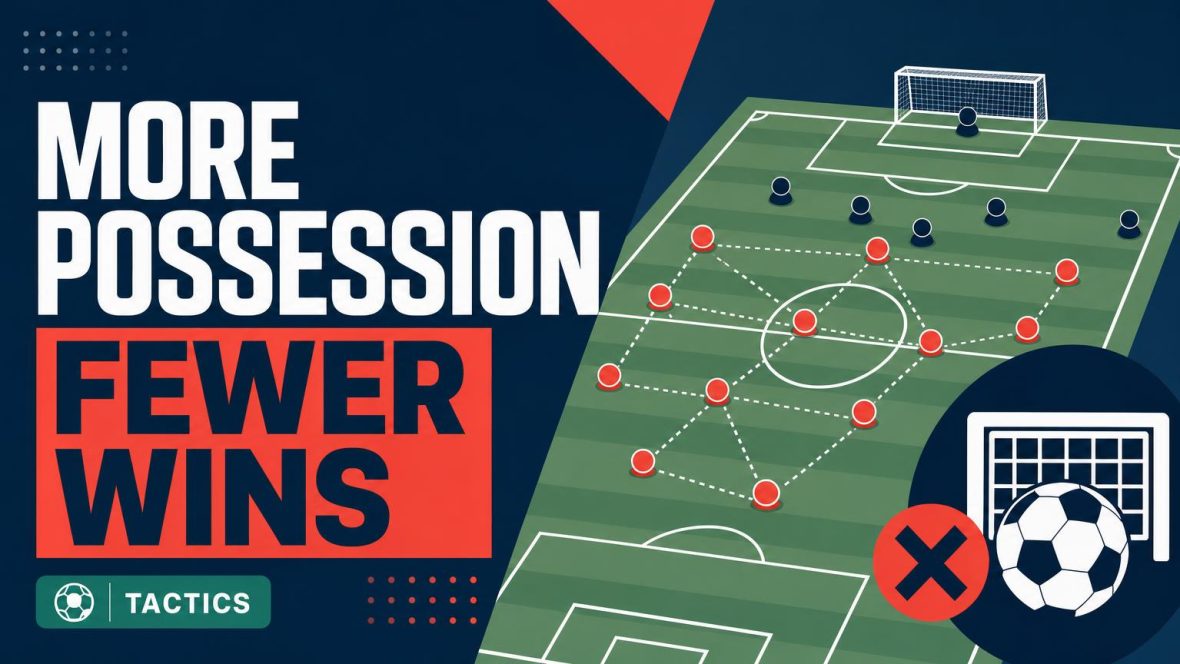
The ball can belong to one team while the match belongs to the other.
The final whistle goes: 65% possession, hundreds more completed passes—and a 1–0 defeat. The numbers suggest command, yet the goalkeeper at the other end may barely have made a difficult save.




That disconnect comes from treating possession as proof of attacking quality. A team can circulate the ball safely between centre-backs, full-backs, and midfielders without breaking a defensive line. Meanwhile, the opponent may willingly surrender harmless areas, stay compact, and wait for one loose pass to launch a counterattack. Possession measures how long a team had the ball; it does not reveal where the ball went, how quickly it moved, or whether it created genuine danger. An impressive share can therefore describe control without penetration—and activity without threat.
It measures ball time, not territory or chance quality.
Centre-backs can trade low-risk passes deep inside their own half.
Direction, location, and defensive pressure give passing its meaning.
Opponents may deliberately concede circulation while protecting dangerous central spaces.
It becomes control when possession changes the opponent’s behaviour.
Useful spells advance play, pin defenders back, create chances, and suppress counters.
When reading possession and passing figures, check what the ball achieved:
Sustained entries into the final third Touches or passes inside the penalty area Chances created from settled possession Quick regains that keep the opponent pinned backA team leading these signs is more likely to control the match. If the ball repeatedly returns to defenders without shifting the opposing block, the percentage mostly represents sterile possession.
A compact defense does not try to contest every pass. It may concede exchanges between center-backs and full-backs while keeping short distances between its midfield and defensive lines. This shape blocks passes into the number 10 area, central combinations, cutbacks, and clear shots inside the box.
The ball can therefore travel repeatedly across the pitch without forcing defenders into difficult decisions. From the outside, that circulation looks patient; to the defending team, it may be exactly the harmless pattern intended.
Possession becomes more meaningful when paired with evidence of territory and threat. Comparing field tilt with possession helps show whether a team is merely keeping the ball or regularly establishing play near the opposition goal.
Three questions offer a clearer picture:
A team can record 65% possession yet create little if most touches remain outside the defensive block. By contrast, a lower-possession side may need only a few central breaks or box entries to reach much better shooting positions. The useful measure is not how long the ball was held, but how often that control disturbed the defense.
A low-possession side can still impose a clear game plan. By protecting the centre and crowding the edge of its penalty area, it funnels possession toward harmless zones. Once the ball is recovered, the team attacks before the opponent can rebuild its shape.
The attacking team’s rest defense—the players positioned to stop counters—often determines whether possession is genuinely secure. If both full-backs advance and midfielders move ahead of the ball, only two centre-backs may remain behind the attack. One poor pass can then create a direct route to goal.
The clearest counterattacking openings commonly follow:
This explains why shot totals can mislead. One team may produce 15 efforts against a settled block, while the opponent creates only five—but takes those shots with fewer defenders between ball and goal. Examining how directly a team advances the ball can reveal this contrast better than possession alone.
The remedy is not simply slower passing. It is maintaining cover behind attacks: staggering midfielders, advancing one full-back at a time, and avoiding forced central passes when the structure is stretched.
A 62–38 possession split can look like territorial dominance, yet the sequence may tell a different story. If the 62% side conceded early, it may have spent an hour passing against a deeper opponent that no longer needed to press or take risks. Possession became a consequence of losing, not evidence that the defeat was undeserved.
This is one of the main score effects that distort possession comparisons. The leading team often exchanges some ball control for compactness, while the trailing team adds attackers, pushes its full-backs higher, and circulates more aggressively.
A more revealing review divides the match into phases:
For example, a team might record 49% possession while the score is level, then finish on 64% after trailing for 50 minutes. The headline number hides the competitive phase. Possession should therefore be read alongside the score at the time, not treated as an even sample of the full match.
Does defeat prove the possession was sterile?
No. A side may create several clear chances, control transitions, and still lose because those chances were missed or saved.
What separates empty dominance from an unfortunate result?
Look at shot locations, clean box entries, and whether attacks forced difficult saves or emergency blocks. Repeated harmless crosses and distant shots suggest a deeper attacking problem.
How useful is expected goals?
xG helps explain why chance quality and the final score can disagree. However, models value situations differently and cannot fully capture every pass, defensive error, or finishing decision.
Can isolated incidents decide the match?
Yes. A set piece, deflection, exceptional save, or rare finishing error can outweigh an otherwise sound performance; ordinary randomness remains part of football.
A narrow loss needs diagnosis, not an automatic tactical overhaul. If good chances were created and counters contained, finishing practice or patience may be more appropriate than changing the entire approach.
After drawing several defenders to one side, the ball should travel across in two or three quick passes. The far-side winger must stay wide enough to receive before the block can slide over.
A midfielder can drop as the full-back advances, while a forward checks short and another runner attacks the space behind. Movements should open different lanes rather than bring more players toward the ball.
If the middle is packed, forcing passes into it usually helps the defense. Width can stretch the block first, creating a later opening for a half-space pass, underlap, or low cross.
Reaching the byline is often more useful than crossing early into a settled defense. One attacker can occupy the near post, another the penalty spot, and a trailing midfielder the edge of the box.
While attacking, two or three players should remain behind or level with the ball, staggered rather than flat. On a turnover, the nearest players press only if they can surround the receiver; otherwise, the team drops and closes central routes.
Progression is not a demand for constant forward passes. A vertical ball is useful when the receiver has support, room to turn, or a planned third-man option. If those conditions are absent, one fast sideways pass may create a much safer route forward.
Possession provides context, not a verdict. A team can dominate the ball while operating in safe areas, creating weak chances, and becoming vulnerable whenever an attack breaks down.
The stronger measure of control is whether a side repeatedly creates dangerous situations while denying the opponent the same. That explains a match more clearly than the possession percentage alone.

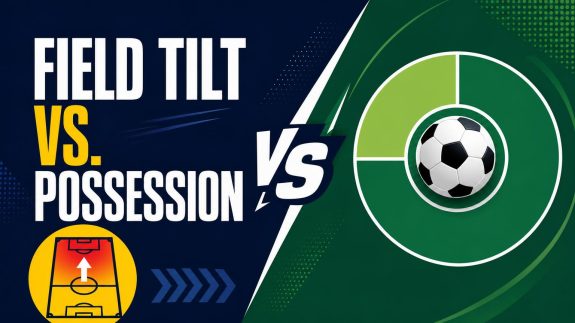
A common version uses completed passes in each team’s attacking third: Team A field tilt…